
Build your timeline from real weekly capacity — and leave room to revise it. "How long should I study for each ARE exam?" is a reasonable question when you are balancing work, appointments, and the rest of your life. A useful ARE exam prep schedule needs more than a target month. It needs an honest weekly capacity, time for practice and review, and a way to respond when your first estimate is wrong.
What NCARB’s completion data actually tells you
NCARB by the Numbers 2026 reports a two-year median ARE completion time for candidates who finished the exam in 2025. The same report says more than 1,000 candidates finished within a year or less. The completion cohort contained just under 3,500 candidates. These figures concern people completing their final division in that calendar year, not everyone currently studying.[1]
Reported in NCARB's 2026 publication. These are elapsed completion times, not logged preparation hours or recommended schedules. [1]
The completion measure spans the exam journey; it is not a count of active study hours and does not capture a universal preparation period before the first exam. You cannot turn the median into "four months of study per division." It provides perspective on how varied real timelines are.
Start with the division, not another person’s deadline
The current ARE 5.0 Guidelines, effective October 1, 2026, define each division’s objectives and exam format. The standard test durations below exclude optional breaks and introductory or closing screens; approved accommodations may change an individual’s timing.[2]
| Division | Total items | Test duration |
|---|---|---|
| PcM · Practice Management | 65 | 2 hr 40 min |
| PjM · Project Management | 75 | 3 hr |
| PA · Programming & Analysis | 75 | 3 hr |
| PPD · Project Planning & Design | 100 | 4 hr 5 min |
| PDD · Project Development & Documentation | 100 | 4 hr 5 min |
| CE · Construction & Evaluation | 75 | 3 hr |
Exam length helps you reserve a practice session. It does not establish how many preparation hours you need. Map your experience to the actual objectives: firm operations for PcM, project delivery for PjM, program and site analysis for PA, integrated design for PPD, documentation for PDD, and construction-phase work for CE.[2]
A designer who regularly coordinates details may have a useful foundation for PDD and still need substantial work on unfamiliar systems. Someone with construction-administration experience may recognize CE situations but need to study the contractual reasoning behind them. Years in an office are a starting clue; what you can explain and apply is more useful.
A transparent example budget for all six divisions
The following is a KPath planning illustration. Its hour budgets are deliberately chosen inputs to demonstrate scheduling. They are not measured candidate averages, NCARB recommendations, or validated amounts needed to pass. Replace each budget after assessing your own scope and pace.
| Division | Example budget | At 8 hr/week | At 12 hr/week |
|---|---|---|---|
| PcM | 48 hr | 6 weeks | 4 weeks |
| PjM | 64 hr | 8 weeks | 6 weeks |
| PA | 64 hr | 8 weeks | 6 weeks |
| PPD | 96 hr | 12 weeks | 8 weeks |
| PDD | 96 hr | 12 weeks | 8 weeks |
| CE | 48 hr | 6 weeks | 4 weeks |
Weeks are rounded up to whole active study weeks. For example, 64 ÷ 12 = 5⅓, rounded up to six. The different budgets illustrate one possible allocation; they do not rank difficulty or prescribe how quickly an experienced candidate should prepare.
- If most objectives are unfamiliar: use the table only as a first draft and allow it to grow. Measure how long it takes to learn a topic and apply it to fresh questions before relying on the date.
- If your work closely matches the division: test that familiarity with unfamiliar scenarios. You may move faster through some material while needing dedicated time for topics your office rarely handles.
- If you have already studied the division: estimate the work still needed. A repeat reading schedule can consume time without addressing persistent errors; rebuilding every topic from scratch may also be unnecessary.
MAKE THE ESTIMATE YOURS
Plan your study time, division by division.
Adjust the hours you still need, the time your week can support, and any weeks away. These starting budgets are editable examples—not measured averages, required study hours, or predictions of passing.
PjM · Project Management
Include learning, practice, error review, and rehearsal. Each division keeps its own hour and pause settings.
YOUR PjM PLANNING WINDOW
10calendar weeks
8 study weeks + 2 weeks away
Use this date for a readiness review. It is not an exam appointment or a passing forecast.
Compare your six plans
Each row is an alternative plan starting on the date above. The rows are not a combined calendar or a recommended exam order.
| Division | Hours left | Hr/week | Study weeks | Weeks away | Calendar weeks |
|---|---|---|---|---|---|
| 48 | 8 | 6 | 0 | 6 | |
| 64 | 8 | 8 | 2 | 10 | |
| 64 | 8 | 8 | 0 | 8 | |
| 96 | 8 | 12 | 0 | 12 | |
| 96 | 8 | 12 | 0 | 12 | |
| 48 | 8 | 6 | 0 | 6 |
Changes stay in this browser when local saving is available.
Change the estimate as practice reveals the work still needed.
Turn a 64-hour estimate into a calendar
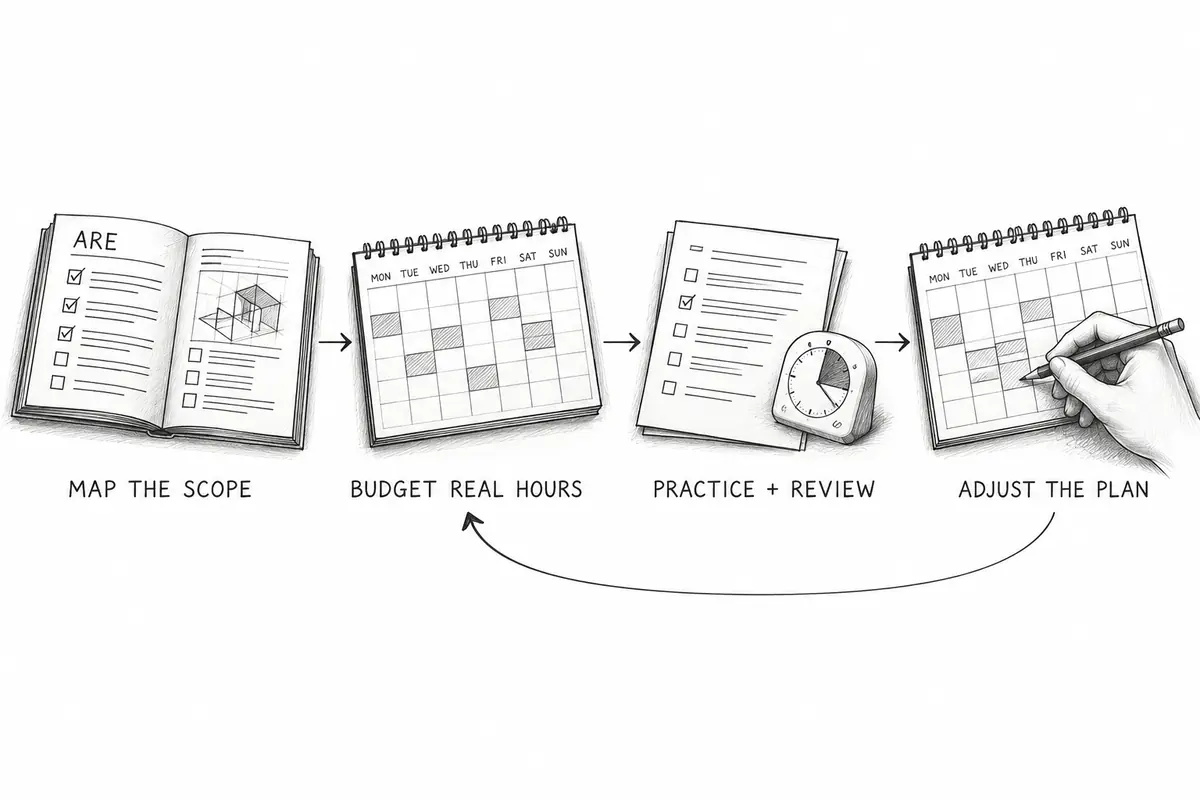
Imagine a working candidate preparing for PjM. After reviewing the objectives and trying a small set of fresh practice questions, they provisionally allocate 64 focused hours. Their calendar reliably supports 8 hours per week.
64 hours ÷ 8 hours/week = 8 active weeks
Two known weeks unavailable for study → about 10 calendar weeks
The candidate reserves 24 hours for learning and targeted reference work, 20 for practice sets, 12 for reviewing errors and revisiting weak topics, and 8 for a full-length rehearsal plus its review. Those allocations total 64 hours; they are teaching assumptions, not an ideal percentage split.
A typical active week might contain four one-hour weekday sessions, a three-hour weekend block, and a separate one-hour review. The long block can accommodate a standard PjM test-duration rehearsal. Book the actual appointment window separately, including applicable breaks, check-in, travel, or online setup.
After two active weeks, the candidate has completed 16 hours and discovers that contract-role errors keep recurring. The decision is not automatically to add another course. First, replace some planned general reading with targeted role scenarios and explanations. If the remaining work still exceeds the available 48 hours, revise the estimate or date.
Count the time spent working attentively on the material. An interrupted evening with a video playing in the background should not be treated as equivalent to an hour of solving questions and reviewing reasoning.
Include practice and the work after it
NCARB offers a free full-length practice exam for each division. Test mode helps rehearse exam conditions; practice mode supplies responses and rationales as you work. Both support review of results.[3] Reserve a long enough block for the format you choose, then schedule separate time to investigate mistakes.
Short sessions can work for comparing two systems, explaining a contract responsibility, or reviewing a small error set. They do not fully reproduce the endurance and navigation demands of a continuous exam rehearsal. A plan composed entirely of short sessions needs a deliberate place for that longer practice.
The KPath checkpoint is to ask: What can I now do that I could not do last week? Useful answers describe a task: interpret a diagram, choose an appropriate response, explain why a tempting option fails, or locate information efficiently. "Finished another chapter" tracks activity, but tells you less about the work still required.
Keep the date connected to the evidence
Review the plan after the first two active weeks and at later meaningful practice checkpoints. Keep the date when unfamiliar questions, explanations, coverage, and timing show steady progress. Change the study mix when errors cluster around one kind of decision. Reconsider the date when broad gaps remain or your actual weekly capacity has fallen.
Three planning mistakes are especially easy to make:
- Borrowing a colleague’s timeline without their experience.
- Treating every study hour as equally productive.
- Filling the calendar so tightly that one missed weekend disrupts everything. Account for known interruptions before calling a schedule realistic.
You do not need to assign six firm dates at once. A well-supported estimate for the next division is more useful than a precise-looking calendar built on assumptions you have not tested. For choosing the order itself, see the ARE 5.0 study plan.
Frequently asked questions
Can I prepare for an ARE division in four weeks?
Possibly, depending on your starting knowledge and available time. Four weeks at 12 focused hours provides 48 hours; four weeks at four hours provides 16. Neither total establishes readiness. Compare the remaining work and fresh practice evidence with the capacity available.
Should I automatically study longer for PPD and PDD?
Budget for their longer exam rehearsal and review their objectives carefully. Your actual preparation time also depends on which systems, integration, and documentation tasks are already familiar. The illustrative budgets above are not universal requirements.
Does NCARB’s two-year median mean I should plan two years?
No. It describes elapsed completion time among 2025 completers. It does not prescribe a personal schedule, and it does not measure the number of hours they spent studying.
Sources and further reading
Sources checked October 28, 2026. All study-hour budgets, weekly schedules, and allocations are original hypothetical planning examples. They are not candidate research or predictions of passing.
- NCARB by the Numbers 2026 — Examination. 2025 completion cohort, median completion time, and number completing within a year. Report year and data year differ.
- NCARB — ARE 5.0 Guidelines, October 2026. Effective October 1, 2026; division objectives and standard division details on printed pp. 72, 78, 85, 92, 99, and 106. See also NCARB ARE 5.0 Test Prep.
- NCARB — Free ARE 5.0 Practice Exams. Formats, modes, and review resources.
Next: check whether your ARE exam preparation shows readiness, or prepare a focused ARE retake plan.