
Read the evidence. Repair the gap. Make the next attempt a different attempt. Failed an ARE 5.0 exam? Your next round of ARE exam prep should begin with a diagnosis: which decisions, skills, or testing habits need to change? Repeating the same notes and familiar questions can make studying feel easier without showing whether you can handle a fresh problem.
First, separate retake eligibility from readiness
Both limits apply; the initial attempt counts. Eligibility remains subject to jurisdiction rules. [6]
The current ARE 5.0 Guidelines, effective October 1, 2026, retain the 60-day interval and 3-attempt limit. These are attempts at the same division, including the initial attempt — not 3 additional retakes. The limit uses any 12-month period, rather than resetting automatically on January 1. The Guidelines also state that a new eligibility after failure is created according to your jurisdiction’s rules. Check your NCARB Record before choosing a date.[1] [6]
Consider an original scheduling example: you have already taken PDD 3 times within the relevant 12-month window. Waiting another 60 days after attempt 3 does not, by itself, authorize attempt 4. Both limits still matter. Avoid building a study plan around a guessed eligibility date.
For preparation, replace "How soon can I go again?" with "What will I do differently before I go again?" A date can create useful structure, but it cannot supply missing evidence.
What the official data says — and what it cannot say
NCARB by the Numbers 2026 · percentages describe attempts, not unique candidates. [2]
NCARB by the Numbers 2026 reports 44,093 ARE division administrations in 2025. Approximately 37% were retakes of previously failed divisions; approximately 63% were first attempts. The denominator is exam attempts, not unique people. One candidate can contribute several administrations, so this does not mean that 37% of candidates failed.[2]
That distinction is useful: retaking a division is a substantial part of the exam process, but population statistics cannot calculate your personal chance of passing next time. Nor do they show which study intervention will work for you. Your next plan needs evidence from your own performance. For how the division-level rates compare, see ARE 5.0 pass rates and their limits.
Read the score report as a map, not an answer key
A scaled score is not a raw percentage. These are not study targets or section cutoffs. [3] [4]
NCARB says official results are normally available within 7–10 calendar days. Provisional feedback at the end of an exam is not the official result. A failed score report provides a scaled score and content-area feedback, including your percent correct compared with the average percent correct of passing candidates. It does not list your missed questions.[3]
The scaled score uses a 100–800 range, with 550 as the passing benchmark discussed in NCARB’s scoring explanation. It is not a raw percentage: dividing 550 by 800 does not produce the exam’s required percent correct. NCARB does not publish a universal scaled-to-raw conversion table.[4]
Likewise, the passing-candidate comparison for a content area is an average, not a separate minimum you must meet in every section. The Guidelines explain that pass/fail is determined across the division as a whole. Use the section information to investigate weaknesses, rather than inventing a pass line for each row.[1]
Turn a weak area into a specific repair
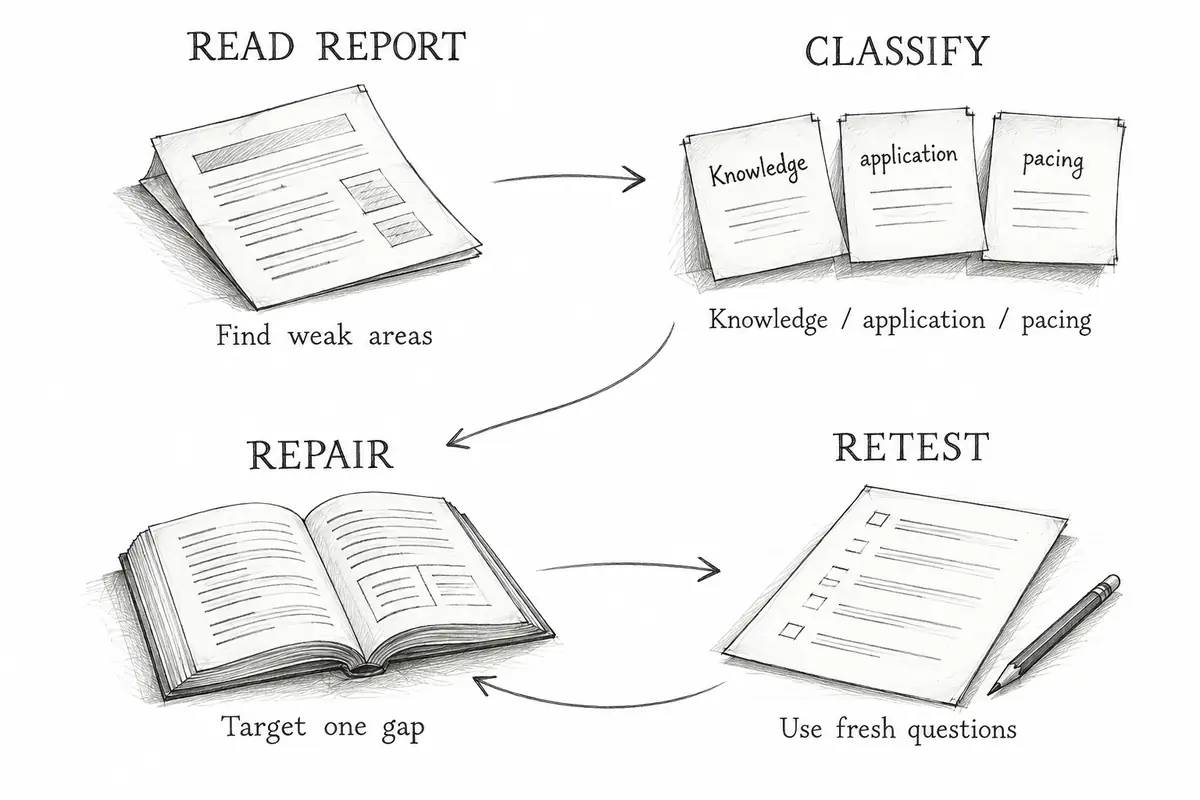
The KPath retake loop is a teaching method: read the report, classify the difficulty, repair it, then retest with fresh work. It is not an NCARB scoring formula. Start with one or two priorities, and ask what kind of difficulty is actually recurring.
| What you observe in practice | Likely issue to investigate | Useful repair |
|---|---|---|
| You cannot explain the relevant principle. | Knowledge gap. | Use an appropriate reference, then explain the principle without notes. |
| You know the definition but choose poorly when conditions change. | Application gap. | Compare two scenarios and explain which condition changes the decision. |
| You solve it untimed but repeatedly run out of time. | Pacing or resource-navigation difficulty. | Practice bounded sets and locating information efficiently. |
| You miss "except," units, or the requested task. | Reading or checking habit. | State the task and units before evaluating options. |
These categories are hypotheses. A slow answer may reflect weak understanding rather than merely slow reading. Test your explanation before selecting the repair. NCARB’s published advice similarly recommends using the score report to build a revised plan and consulting the Guidelines’ recommended references.[5]
An original PjM retake example
A candidate identifies project work planning as a weak area. During new practice, they can describe staffing and scheduling concepts, but repeatedly select a staffing response before checking the available fee and scope. Their initial conclusion is "I need to memorize more terms." The observed pattern suggests a decision-sequence problem instead.
The repair is specific: for each original planning scenario, identify the scope, remaining effort, available resources, and constraint before choosing an action. Explain why the tempting alternative fails under those conditions. Then use a different scenario with a changed constraint to see whether the reasoning transfers.
Suppose the candidate completes a fresh 24-question practice set and answers 16 correctly: 16 ÷ 24 = 66.7%, rounded to one decimal place. That is a practice-set result, not an ARE scaled score or a validated passing prediction. Review the 8 errors and any correct guesses. If the same sequence error recurs, the repair needs more work even though the overall percentage has improved.
A manageable retake plan for a working candidate
KPath planning assumption: 8 × 6 = 48 hours. Six study weeks do not override the 60-day retake rule.
Here is a KPath planning example, not an official study-duration recommendation: 8 focused hours per week for 6 active weeks gives 48 hours. Adjust the workload to your diagnosis and available time. 6 weeks of study does not override the 60-day retake rule.
| Block | Hours | Deliverable |
|---|---|---|
| Weeks 1–2: diagnose and rebuild | 16 | 2 hours diagnosis, 10 focused reference review, 4 short application exercises. |
| Weeks 3–4: apply and compare | 16 | 8 hours unfamiliar scenarios, 8 reviewing reasoning and repairing recurring errors. |
| Weeks 5–6: mix and verify | 16 | 10 hours mixed/timed work, 6 reviewing remaining gaps and testing conditions. |
Keep stronger areas in the mixed work. A retake plan should repair weaknesses without letting the rest of the division disappear. If a week becomes unavailable, revise the calendar rather than compressing its hours into exhausted late-night sessions. For the broader picture across all six divisions, see the ARE 5.0 study plan.
Three habits that make a retake less useful
- Repeating a question until its answer feels obvious. Familiarity can hide weak reasoning. Explain the answer, then check the concept in an unfamiliar scenario.
- Treating every error as a need for more reading. Some errors need application practice, navigation practice, or a checking routine.
- Reconstructing the live exam. Keep notes about broad skill gaps and testing habits, not recalled questions, answer choices, or exam content. Follow the Candidate Agreement.[1]
If your attempt involved a testing problem, use the appropriate reporting channel rather than treating it only as a study issue. The current Guidelines state that NCARB can respond only to complaints received within 15 days of the test date; a proctor’s report does not replace notifying NCARB directly.[1]
Retake questions candidates ask
How soon can I retake a failed ARE division?
NCARB allows a retake as soon as 60 days after the previous attempt, with no more than 3 attempts at the same division in any 12-month period. The initial attempt counts toward the 3, and your jurisdiction’s rules still apply.
Should I retake as soon as I am eligible?
Consider it when the weak areas have changed in demonstrable ways: you can explain the principle, apply it in fresh work, and manage the required pace. Eligibility alone is insufficient. There is no universal practice-score percentage that guarantees an ARE pass.
Does a scaled score of 550 mean I need about 69% correct?
No. The 100–800 scale is not a raw percentage, and NCARB does not publish a universal scaled-to-raw conversion table. Dividing 550 by 800 does not give the required percent correct.
Can I study a different division while waiting?
You can use the waiting period to work on another division when your eligibility and schedule allow. As a planning choice, weigh the overlap against the risk of abandoning the repair you identified. Give the failed division a defined maintenance routine if you shift focus.
What evidence should I bring to my next readiness decision?
A short error log showing fewer recurring mistakes, explanations you can produce without notes, and unfamiliar mixed practice completed at a workable pace. For a broader final check, use the ARE exam readiness guide.
Sources and further reading
Checked October 26, 2026. Policies are current guidance, not newly announced changes. Study allocations and the PjM scenario are original teaching examples.
- NCARB — ARE 5.0 Guidelines, October 2026. Effective October 1, 2026; pages 40–44 cover scoring, unsuccessful attempts, reporting concerns, and security.
- NCARB by the Numbers 2026 — Examination. 2025 administration counts and first-attempt/retake shares. Percentages describe attempts, not unique candidates.
- NCARB — Receiving Your Score. Official reporting window, provisional feedback, and score-report contents.
- NCARB — Understanding Exam Scoring. July 17, 2024; scaled scores and limits of raw-score interpretation.
- NCARB — How to Overcome Failing a Division. October 3, 2023; background on diagnosis and resources, not a 2026 policy announcement.
- NCARB — How soon can I retake a failed division? Minimum interval and the same-division attempt limit.
Next: check your ARE exam readiness before you book the retake.