
You are ready to consider taking an ARE 5.0 division when your ARE exam prep produces repeatable evidence: you can handle unfamiliar questions, explain your decisions, cover the division’s objectives, work within the available time, and resolve recurring mistakes. A practice score helps, but its meaning depends on the questions, testing conditions, and whether you have seen the answers before.
This ARE 5.0 exam prep checklist is for candidates preparing for the Architect Registration Examination. Finishing a course tells you what you have studied; readiness asks what you can do with it. Use the five checks below to make your next study session — and your decision about exam day — more specific.
1. What your ARE practice exam score tells you
NCARB offers free, full-length practice exams for each division. Test mode rehearses an appointment; practice mode provides answers and rationales as you work. Use the former to observe your performance and the latter to investigate your reasoning.
Record four things beside every result: first attempt or repeat, timed or untimed, closed-book or assisted, and the source. A percentage without those details can hide the problem you need to solve.
NCARB’s divisional practice exams use a cut score of approximately 68%. Its actual exam cut scores vary by division and form. NCARB’s scoring explainer, updated June 30, 2025, reports these ranges:
| Divisions | Published range |
|---|---|
| PcM + PjM | 59–71% |
| PA + PPD | 65–71% |
| PDD + CE | 58–66% |
These are ranges across exam forms, not thresholds you can select for your appointment. They apply to scored items, not simply all questions displayed. A question-bank percentage is not automatically equivalent to an NCARB practice result or an actual ARE result.
Use the reported result as one piece of evidence. Then inspect the errors, time pressure, and unfamiliar topics behind it.
2. What the official data adds
NCARB by the Numbers 2026 reports 2025 exam outcomes, not a forecast for your next appointment. Four figures help put readiness in context:
| Measure | Reported result | Who is being compared? |
|---|---|---|
| Overall pass rate | 55% | Division attempts, including first attempts and retakes. |
| First-attempt pass rate | 60% | First attempts at a division, averaged across divisions. |
| Second-attempt pass rate | 51% | Second attempts at a previously failed division. |
| Prior NCARB practice-exam use | +15 percentage points | Candidates who used the related practice exam versus those who did not. |
A 55% pass rate is not a 55% passing score. One describes successful attempts in a population; the other would describe answers on an individual exam.
The practice-exam difference is measured in percentage points, not a 15% relative increase. These group comparisons are observational: differences in preparation, experience, and other factors may contribute. They do not establish that taking a practice exam causes a 15-point increase in your personal chance of passing.
KPath’s planning takeaway: use the official practice exam to expose weaknesses, then act on them. The first-versus-second-attempt figures do not show that retaking itself causes lower performance — or that a worried candidate should rush a first attempt.
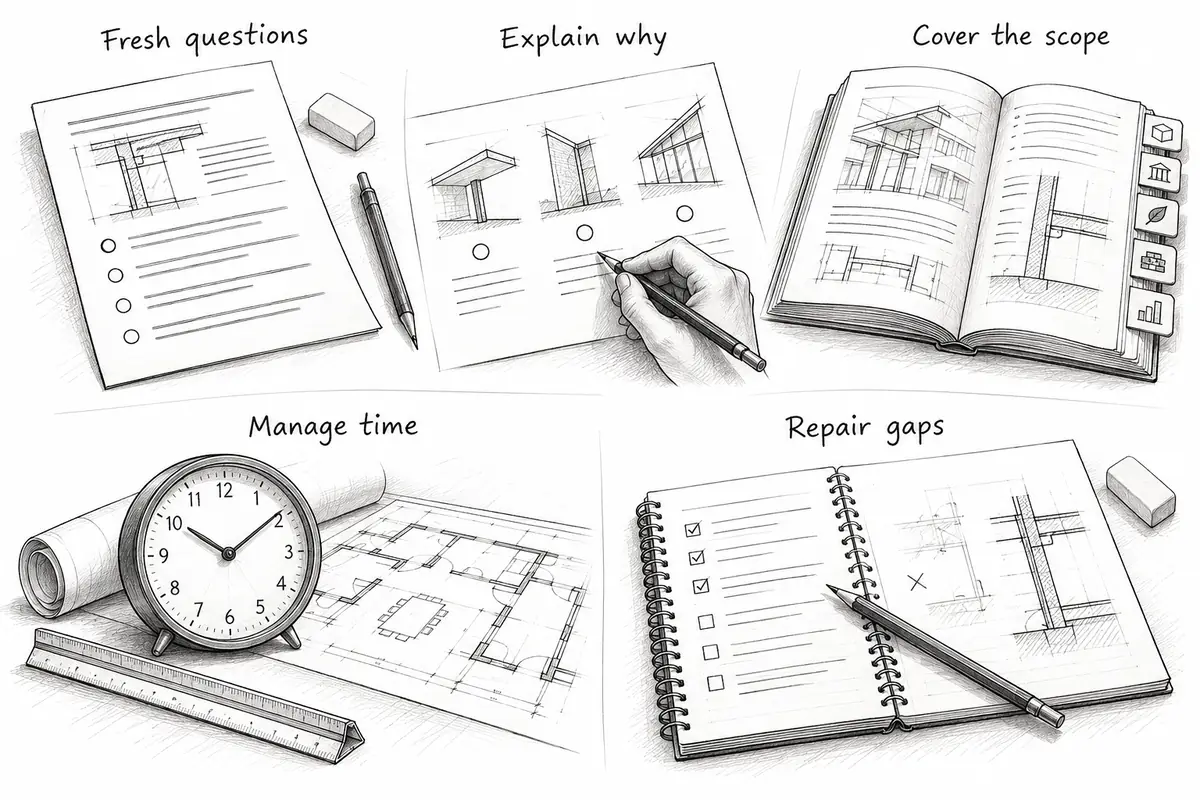
3. An ARE prep checklist: five kinds of evidence
| Check | Useful evidence | Next action |
|---|---|---|
| Fresh questions | You can approach unfamiliar scenarios without recognizing the answer. | Try a fresh, relevant mixed set. |
| Explain why | You can connect your choice to the controlling requirement. | Explain the closest competing option. |
| Cover the scope | You have tested yourself across the division's objectives. | Check an underpracticed area. |
| Manage time | You can complete a realistic rehearsal, including resource-based work. | Rehearse the part that consumes time. |
| Repair gaps | A previously missed concept makes sense in a changed scenario. | Review the principle, then apply it again. |
Fresh questions: separate learning from recognition
Repeating questions can reinforce a lesson. It becomes weaker evidence of readiness when you remember an option’s wording before you analyze the problem. Keep repeat-set results separate from first-attempt results.
If fresh material is limited, change a practice scenario’s constraint and explain how your decision changes. Use that exercise for learning, not as a newly calibrated readiness score.
Explain why: check correct guesses, too
After a practice set, choose a few correct answers and explain them without reading the rationale. What fact controlled the decision? Why was the nearest alternative less appropriate? What changed condition would make that alternative reasonable?
Include correct guesses in your review log. If you cannot reconstruct the reasoning, the correct response has identified another concept to revisit.
Cover the scope: audit what your routine leaves out
Use the current NCARB Guidelines to map your preparation to the division’s objectives and section weightings. The edition checked for this article is effective October 1, 2026. Beside each objective, note whether you can explain it, apply it in an unfamiliar scenario, or still need help.
For example, PPD assigns 32–38% of items to Project Integration of Program & Systems, compared with 19–25% to Building Systems, Materials, & Assemblies. PDD includes construction documentation and specifications alongside systems integration. Comfort with structural questions alone leaves important areas untested.
Manage time: rehearse the work, not just the clock
Use your division’s current duration and approved testing conditions. PPD and PDD each have 100 items and 4 hours 5 minutes of standard testing time. That is 245 minutes ÷ 100 = 2 minutes 27 seconds per item on average — a KPath calculation, not an official per-question limit.
Some questions need more time than others. Use that average to notice whether your overall pace is sustainable, while leaving room for resource-heavy items. Observe whether reading, searching, calculations, or reconsideration consumes the time.
Case studies require you to evaluate their supporting resources. Practice finding the information needed for the question instead of trying to absorb every page first. If navigation is the bottleneck, more untimed reading will not reveal whether your process is improving.
Rehearse your break decision, too. Under the current Guidelines, returning from a break locks every item you have already viewed, including unanswered or flagged items. Build a routine for checking those items before you take the break.
Repair gaps: test the principle again
A useful error log names the cause: missing knowledge, misreading a constraint, choosing the wrong relationship, or losing time finding evidence. "Study HVAC" is difficult to act on. "Explain why this system fits the stated operating schedule" gives you a task.
After reviewing the source, close it and explain the principle. Later, apply it to a different scenario. Mark the gap as improving when the reasoning transfers — not simply when the original answer looks familiar.
4. Example: a promising score with a specific weakness
Illustrative study scenario — not candidate research: Maya earns 74% on her first timed NCARB PPD practice attempt. She finishes, but several case-study responses are guesses because she spends too long locating information. She also notices repeated errors in project costs.
The percentage alone cannot settle her readiness decision. Her review points to two concrete tasks:
- Resource use: practice stating which document and piece of information the question requires, then locate it before answering.
- Project costs: revisit the principles behind the errors and work through unfamiliar, relevant examples.
Next, she tries a fresh timed mixed set and includes resource-based work. She records whether those same problems recur. A higher score from repeating the original questions would not answer that question as clearly.
In a KPath study session, use the same sequence: identify the gap, revisit the relevant lesson, and apply the idea again. The aim is to improve the particular decision or process that caused the miss.
KPATH · LOOK BEHIND THE SCORE
Same score. Different evidence.
Drag the three switches. The score stays fixed; the evidence behind it changes.
A practice result.
What does it demonstrate?
Recognition may help
Pace remains untested
Reasoning remains unclear
WHAT THE EVIDENCE SUPPORTS
Familiar answers, unlimited time, and correct guesses can produce a comfortable percentage without showing how you handle unfamiliar work.
Next: Try an unfamiliar scenario and explain your decision.
A conceptual comparison, not a readiness score or pass prediction. Actual preparation also needs content coverage and evidence that recurring gaps have improved.
Read the principles behind the model
- Repeated → fresh: A remembered answer provides weaker evidence of applying a principle to unfamiliar work.
- Untimed → timed: Finishing under realistic conditions provides evidence about pace. It does not resolve a knowledge gap.
- Guessed → explained: Explaining the controlling requirement and the closest competing option makes your reasoning visible.
All three together provide more useful evidence than the percentage alone. They still do not establish that a candidate will pass.
5. Make the next step specific
Write a short readiness note before deciding whether to keep your appointment:
- Evidence: What can I now do on unfamiliar work?
- Remaining gap: What repeatedly breaks down?
- Repair: What task would address it?
- Recheck: How will I see whether that repair worked?
If the remaining issue is narrow and you can demonstrate improvement, focus the remaining study time there. If several important areas remain unfamiliar or you have not completed a realistic rehearsal, gather that evidence before relying on a comfortable overall percentage. Check current appointment rules before making a scheduling change.
An example working-professional routine is one diagnostic session, two targeted reviews, one fresh application session, and a timed rehearsal. Adjust this workload to your available time.
Frequently asked questions
Does passing the NCARB practice exam mean I will pass the ARE?
It is useful evidence, not a guarantee. Consider whether the attempt was fresh, the conditions were realistic, and the reasoning was sound. The actual exam and practice exam do not share one universal percentage threshold.
How can I tell if my ARE prep is enough?
Compare your ARE exam preparation with the division’s objectives. Look for repeatable application on unfamiliar questions, realistic timing, and progress on recurring mistakes. Use remaining gaps to choose the next task rather than waiting for complete certainty.
What if I have already repeated all my questions?
Use them to explain principles, not to generate a new readiness score. Add unfamiliar, relevant scenarios where available and keep their results separate from remembered material.
Sources
Official information checked October 22, 2026. NCARB by the Numbers 2026 statistics describe 2025 outcomes. The framework, illustrative scenario, review routine, and timing arithmetic are KPath teaching material.
- NCARB — Free ARE 5.0 Practice Exams: divisional practice exams, modes, feedback, and the approximate practice cut score.
- NCARB — What Score Do You Need to Pass the ARE?: updated June 30, 2025; practice benchmark and actual cut-score distinctions.
- NCARB — ARE 5.0 Guidelines, October 2026: effective October 1, 2026; objectives, delivery, navigation, and breaks.
- NCARB — Project Planning & Design: division scope.
- NCARB — Project Development & Documentation: division scope.
- NCARB — ARE 5.0 Question Types: resource-based case-study work.
- NCARB by the Numbers 2026 — Examination: 2025 first- and second-attempt rates and prior-practice-exam comparisons; observational population data.
- NCARB — ARE 5.0 Pass Rates: 2025 overall rate; includes first attempts and retakes.