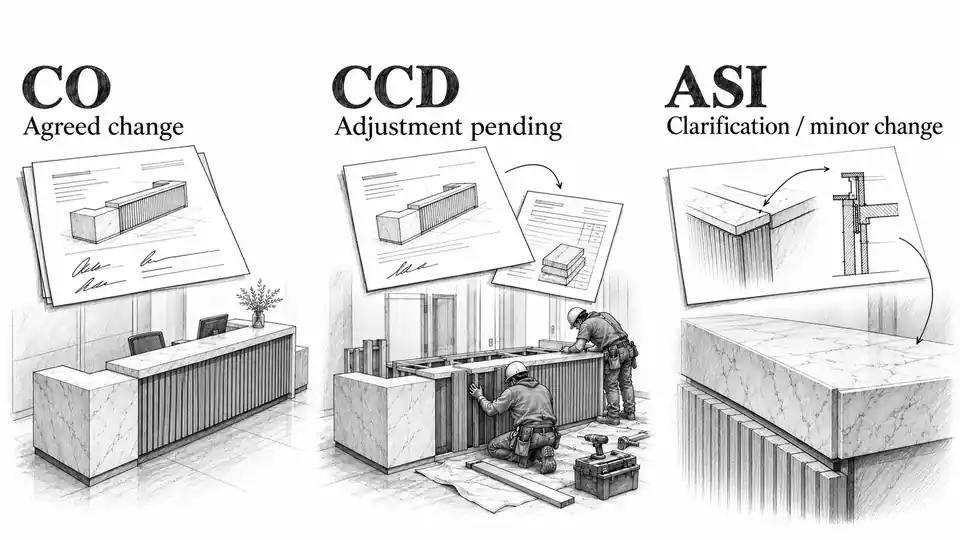
Connect each construction-administration issue to the right document, the right reviewer, and the next action — before reaching for a specific AIA form number. Five decisions repeat across site visits, submittals, payment applications and closeout: which change document applies, who is actually reviewing what, how a defect gets corrected, what a payment application really owes, and when the project is actually done.
For ARE Construction & Evaluation (CE), these five decisions cover a large share of the construction-administration content. This KPath study guide works through each one with an original illustration, a short example, and three practice questions.
Where this fits in the CE exam
| Content section | Target range | Topics in this guide |
|---|---|---|
| Preconstruction Activities | 17–23% | Delivery method, bidding, qualifications, cost/scope/schedule adjustments |
| Construction Observation | 32–38% | Nonconforming work and uncovering costs; progress, schedule, critical path |
| Administrative Procedures & Protocols | 32–38% | RFI / CO / CCD / ASI, submittals, payment and retainage |
| Project Closeout & Evaluation | 7–13% | Substantial vs. final completion; punch list, O&M, warranties |
1. Change Order, CCD and ASI
Three documents move work forward during construction, and the exam rewards knowing which one fits a given moment: have the Owner and Contractor actually agreed on the price and time effect, and does work need to start before that agreement is reached?
- Change Order (CO). Records an agreed change and its agreed effect on the Contract Sum and Contract Time — even when that effect is zero. Owner, Contractor and Architect all sign it.
- Construction Change Directive (CCD). Directs a change before the parties fully agree on price or time. Owner and Architect sign it; the Contractor proceeds under the directive while the adjustment is worked out.
- Architect’s Supplemental Instructions (ASI). A clarification, or a minor change consistent with the contract’s intent, issued without a sum or time adjustment. If the Contractor believes a so-called minor change actually affects cost or time, it must give the required notice before proceeding — an ASI cannot bypass that formal change workflow.
Example: a revision enlarges the reception desk. If the price is still unresolved and work must proceed now, that’s a CCD. If the change and its price/time effect are already agreed, it’s a CO.
2. Submittals and who reviews what
A submittal — a shop drawing, product data, or sample — shows what the Contractor proposes to build or supply. Two different reviews happen before a submittal is considered settled:
- The Contractor checks field information and coordination before forwarding a submittal.
- The Architect (or consultant) reviews it for conformance with the design concept and the Contract Documents, within the scope the contract actually assigns to that review.
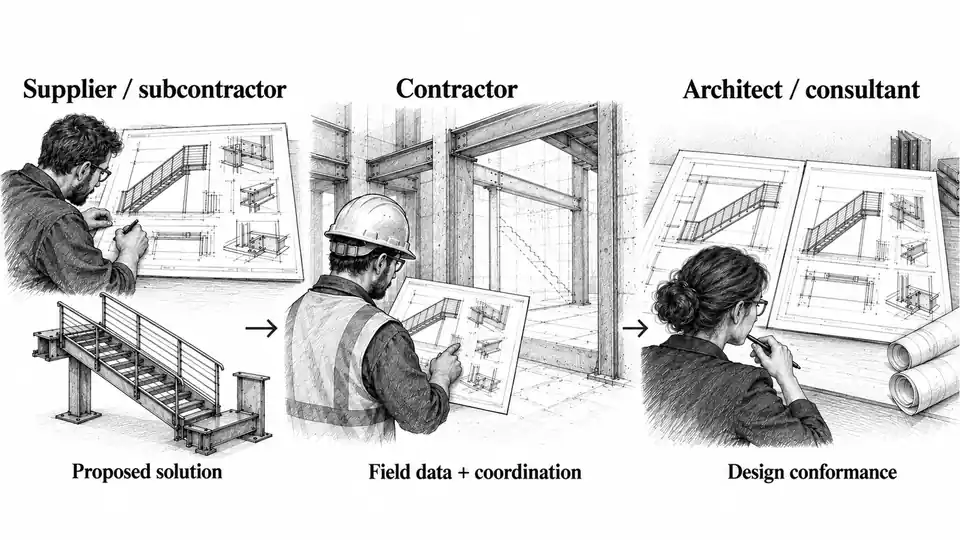
Example: a stair shop drawing arrives without the Contractor’s own review. Return it for that review, and flag any apparent design conflict separately.
3. Nonconforming work and the cost of uncovering it
Nonconforming work fails to meet what the Contract Documents actually require — compare the observed condition against the real requirement, then document and address the mismatch.
Example: required flashing was left out. Adding it corrects the defect; it isn’t automatically extra scope. If the Owner now wants work beyond the original contract, that gets evaluated as a change.
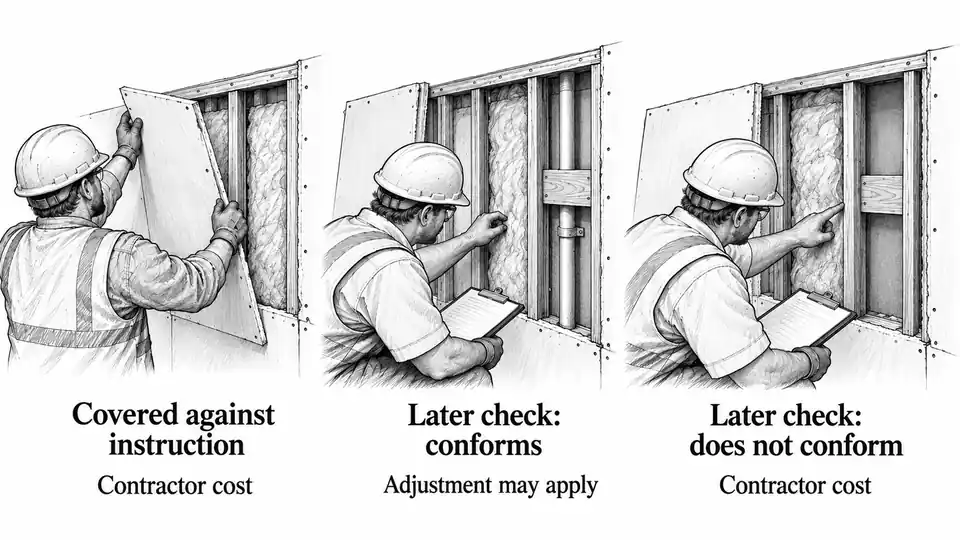
The uncovering question turns on one fact: was there a prior requirement or request to examine the work before it was covered?
- If work was covered against an instruction or request to examine it, the Contractor pays to uncover and restore it, with no added time.
- If there was no such prior requirement, a later examination of conforming work may justify a sum or time adjustment for the Owner. Nonconforming work found that way is still uncovered and corrected at the Contractor’s expense.
4. Reading a progress-payment application
Retainage is an amount withheld under the payment terms; its rate and release conditions come from the specific contract, not a fixed industry number.
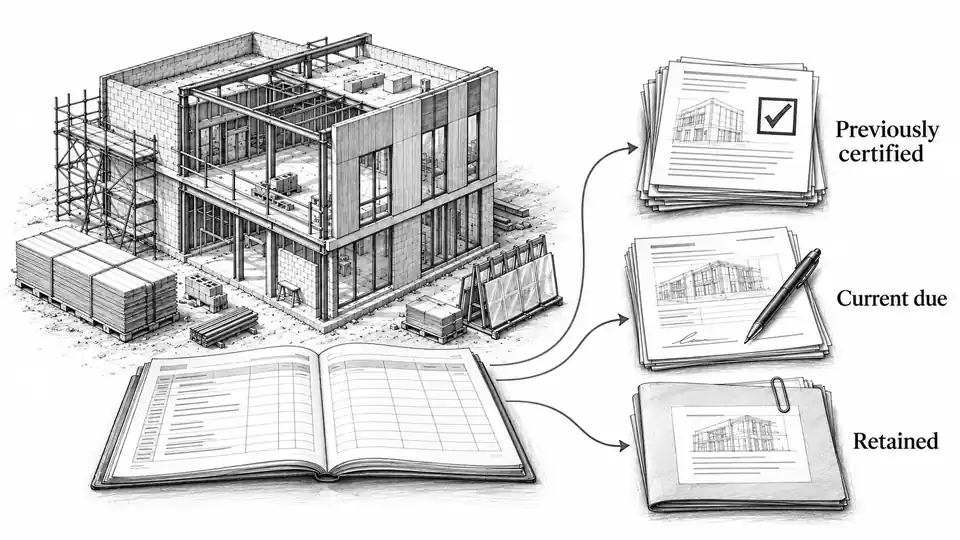
Completed work plus eligible stored materials, minus retainage, minus amounts already certified, equals the amount currently due. "Not yet installed" doesn’t automatically mean "not payable" — materials stored off-site can still qualify once a contract’s approval, storage and protection conditions are met.
| Line | Amount |
|---|---|
| Completed work + eligible stored materials | $320,000 |
| Retainage (10%) | − $32,000 |
| Earned less retainage | $288,000 |
| Previous certificates | − $188,000 |
| Current amount due | $100,000 |
$188,000 previously certified + $100,000 current due + $32,000 retained = $320,000.
5. Substantial completion vs. final completion
Substantial completion means the work is far enough along for the Owner’s intended use. The Architect evaluates the milestone and prepares its certificate; Owner, Contractor and Architect all sign it. Punch-list items may still remain.
Final completion means the remaining work, and the required closeout conditions, are satisfied — manuals, warranties, and record information among them.
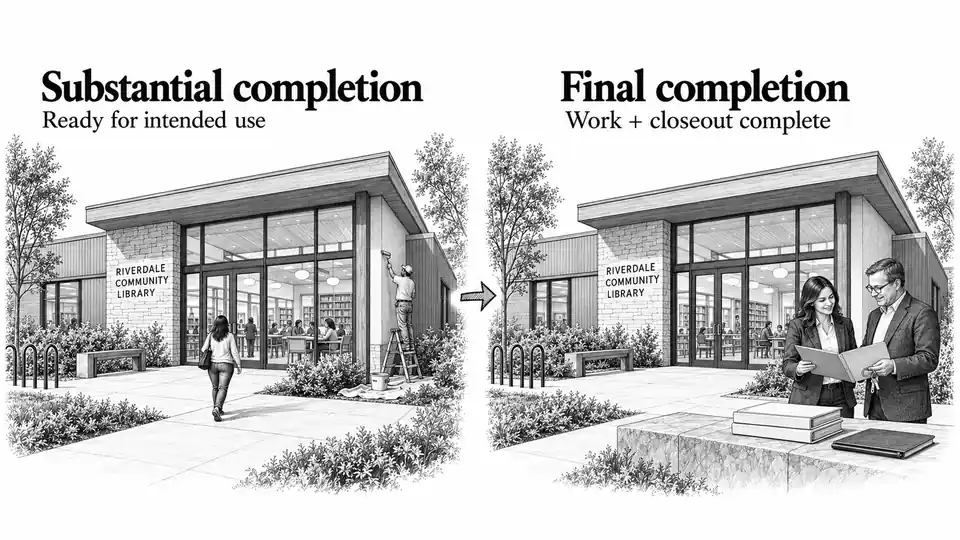
Example: minor paint touch-ups can remain at substantial completion. A missing essential life-safety component can prevent it.
6. Check your understanding
Three original practice questions apply the five decisions above.
Frequently asked questions
What’s the difference between a Change Order, a CCD, and an ASI?
A Change Order records an agreed change and its agreed price and time effect, signed by the Owner, Contractor and Architect. A Construction Change Directive directs work before that agreement is reached, signed by the Owner and Architect, with the Contractor proceeding under the directive. An ASI is an Architect-issued clarification or qualifying minor change made without any sum or time adjustment.
Does Architect review of a submittal make the Contractor’s work correct?
No. Architect review checks conformance with the design concept and the Contract Documents within the agreed scope of that review. It does not verify the Contractor’s field coordination or accuracy, and it does not transfer the Contractor’s responsibility for the submitted work.
If uncovered work turns out fine, does the Owner owe anything for uncovering it?
It depends on whether a prior examination was required or requested. Without that prior requirement, uncovering conforming work can justify a sum or time adjustment for the Owner. If the work was covered against an instruction to examine it, the Contractor bears that cost.
What goes into the amount currently due on a progress payment?
Completed work plus eligible stored materials, minus retainage, minus amounts already certified in earlier payment applications. Retainage rates and release conditions come from the specific contract, not a fixed industry number.
Can stored materials be included in a payment application before they’re installed?
Yes, when the contract’s approval, storage and protection conditions for off-site materials are met. "Not yet installed" doesn’t automatically mean "not payable."
What’s left to do between substantial and final completion?
The remaining punch-list work, plus the closeout conditions the contract requires — commonly manuals, warranties and record information — before final completion and the final payment application.
Which ARE 5.0 division tests this content?
These five concepts sit inside Construction & Evaluation (CE)’s administration-of-the-contract domain: document choice, submittal review, nonconforming work, payment calculations and project closeout.
Course lessons and sources
Continue in the KPath course
Review the connected knowledge points.
CCD and Change Order differ on agreementCE.D5.CHANGE.018 Architect review is limited to conformance with design concept and Contract DocumentsCE.D3.SUBM.004 Covered without a prior examination requestCE.D4.NONC.015 Subtract previous certificates to find current paymentCE.D6.CALC.005 Keep Substantial Completion separate from Final CompletionCE.D8.SUBC.002Lessons open in your KPath account — sign in or create a free account to continue.
Sources checked November 1, 2026. Examples, questions and the study sequence are original KPath teaching material.
- NCARB — ARE 5.0 Guidelines: CE content sections and target ranges.
- AIA — Change Orders, Construction Change Directives, and minor changes
- AIA — Contractor review of subcontractor submittals, A201–2017 §3.12.6
- AIA A201–2017 official sample: §§4.2.6–4.2.7 and 12.1.
- AIA — G711–2018 field report and limits of site observation
- AIA — A101–2017 instructions, progress payment and retainage provisions
- AIA — Stored materials and A201–2017 §9.3.2
- AIA — G704–2017 substantial completion instructions
- AIA — Correction period and warranty distinction
- AIA — Owner’s right to carry out the work under A201–2017 §2.5