
Can you become an architect without a NAAB-accredited degree — and what does that mean for your ARE exam prep? NCARB’s 2026 report offers useful context, provided you keep education eligibility, professional experience, and exam preparation separate.
Read the year — and the population
This is an interpretation of NCARB by the Numbers 2026: Building Toward Competency, primarily describing 2025 outcomes. New architects, exam candidates, and AXP completers are different populations. The figures below should not be combined into one imagined "typical candidate."[1]
A person who completed AXP last year may still be taking exams. A newly licensed architect may have finished experience much earlier. Reading every number as a milestone on the same timeline creates a story the data does not establish.
KPath perspective: use the report to ask better planning questions. Which requirement applies to my education? What experience remains undocumented? Which exam decisions can I explain on unfamiliar questions? Those questions lead to actions you can control.
A non-NAAB path is a jurisdiction question
The education chart shows that 13% of new architects in 2025 had no degree from a NAAB-accredited program, compared with 11% in 2024. That is a two-percentage-point increase — not a two-percent increase. The report describes 19 jurisdictions offering multiple initial-licensure pathways and 49 offering multiple reciprocal pathways in 2025. Treat these as report-period counts, not a current eligibility list.[1]
A growing share took another education path
Newly licensed architects without a degree from a NAAB-accredited program · share of each year's new architects
View exact published values
| Year | Published value |
|---|---|
| 2024 | 11% |
| 2025 | 13% |
KPath perspective. A national trend is a reason to investigate your options, not evidence that your chosen board accepts your particular education.
Initial licensure is your first license. Reciprocal licensure concerns an additional jurisdiction after you are licensed. NCARB’s Education Alternative to Certification serves already licensed U.S. architects; it is not a universal shortcut to a first license. The available certification routes and their eligibility conditions are described separately by NCARB.[4]
Before paying for another degree, make a short written record: intended jurisdiction, exact program and graduation date, the board’s education route, any evaluation needed, and additional experience conditions. Ask the board to resolve ambiguous qualifications. A school’s reputation or the word "architecture" in a degree title is not a substitute for checking the applicable program status and requirements.[5]
More degrees do not automatically mean a better plan
NCARB’s degree-count chart labels the 2025 newly licensed cohort as 48% with one degree, 50% with two, 2% with three or more, and 0.3% without a degree. Those rounded values sum to 100.3%; they should not be used to calculate exact numbers of people.[1]
Degree count is not accreditation status
Architects newly licensed in 2025 · percentage in each published degree-count category
View exact published values
| Category | Published value |
|---|---|
| One degree | 48% |
| Two degrees | 50% |
| Three or more | 2% |
| No degree | 0.3% |
KPath perspective. Counting qualifications cannot tell you whether the particular program meets your jurisdiction's education requirement.
Degree count and accreditation describe different things. Someone can hold multiple degrees and still need to clarify how their education satisfies a board’s requirements. Conversely, an additional degree may be valuable for a particular professional goal without being the right response to a recurring exam mistake.
NCARB reports that candidates holding both accredited-program and nonaccredited-program degrees performed two percentage points above the national ARE average overall. This is a group association. It does not isolate the effect of an additional degree, establish a personal passing probability, or prove that returning to school is an effective retake strategy.[1]
Our interpretation: diagnose the decision you cannot yet make. If you understand an assembly’s components but miss questions about continuity, practice tracing its connections. If you confuse project roles, compare responsibilities within the applicable agreement. More general reading may leave the specific misunderstanding untouched.
Why the AXP median needs a policy footnote
AXP time declined. The reporting rules changed too.
Median elapsed years among candidates completing AXP in the indicated year
View exact published values
| Year | Published value |
|---|---|
| 2024 | 4.8 yr |
| 2025 | 4.3 yr |
KPath perspective. The 0.5-year decrease is descriptive. Changing credit and backdated records make it unsuitable as a clean measure of individual productivity.
The AXP reporting change was announced September 16, 2025, and became effective November 18, 2025. It expanded full-credit reporting to one year and allows 75% credit for older qualifying experience without an age limit. Previously, the full-credit window was eight months, followed by 50% credit up to five years. The change also applied retroactively to affected reports.[2]
NCARB counts experience participation and completion using when work was performed, rather than simply when a report arrived. Backdated reporting can therefore revise earlier years. A shorter recorded interval may reflect restored credit and changed records, alongside differences between cohorts. It cannot establish that an individual now needs fewer working hours or less preparation.[1]
The current reporting policy also distinguishes submission from approval: experience submitted within the full-credit window retains that value even if the supervisor approves it later. Approval still matters to completion. These details make regular recordkeeping useful even when a deadline feels distant.[3]
A worked example: credit is not the same as speed
Original teaching example: suppose a qualifying, approved report contains 400 hours, all earned two years before submission. Assume it meets the relevant experience-setting and supervision conditions. Compare only the reporting-credit rules.
| Reporting policy | Calculation | Recognized credit |
|---|---|---|
| Previous policy | 400 × 50% | 200 hours |
| Policy effective Nov. 18, 2025 | 400 × 75% | 300 hours |
| Difference | 300 − 200 | +100 hours |
The candidate performed no extra work in this comparison. The policy recognizes more of the same work. That is a concrete reason to separate credit gains from productivity gains. The example applies the published percentages; it does not determine whether a specific report qualifies or completes an experience area.[2]
Turn the data into three practical checks
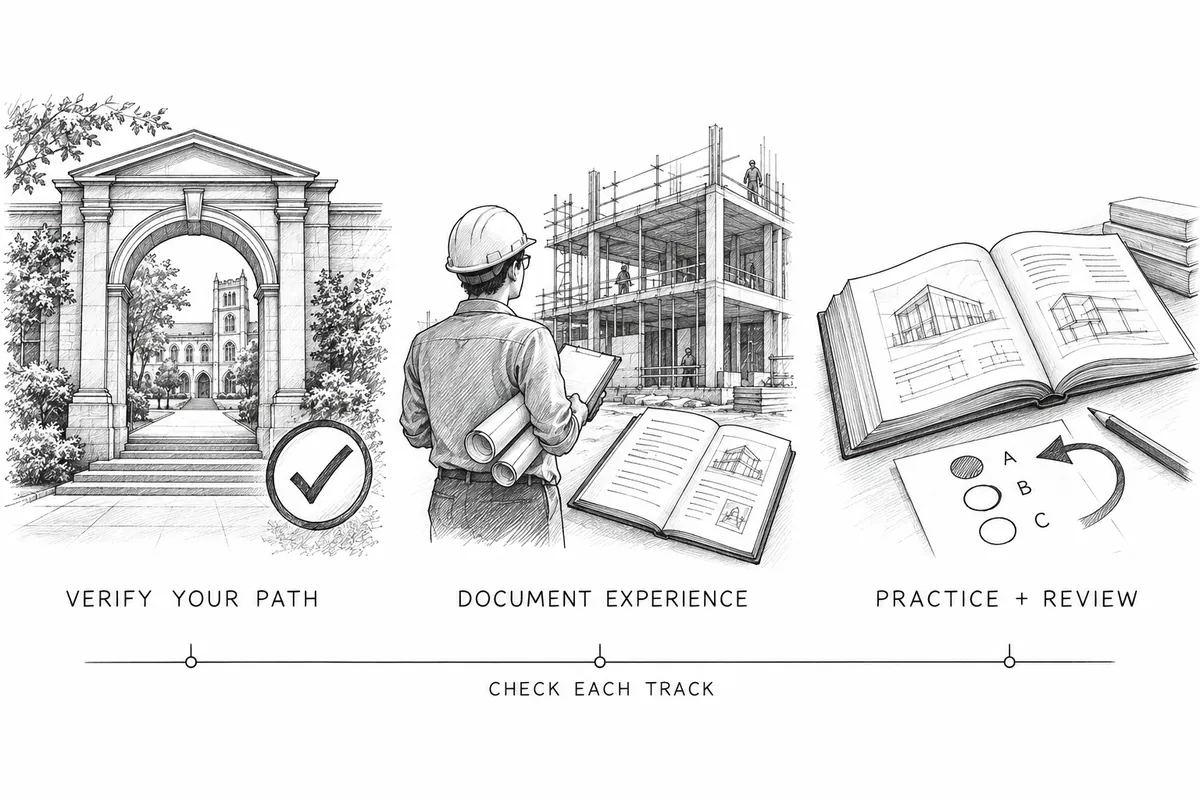
- Verify your path. Confirm the applicable board requirements before choosing an expensive education change. Keep initial licensure and later mobility questions separate.
- Document experience. Review missing reports and approval status. Use the current AXP Guidelines to distinguish eligible work, required experience areas, and reporting credit. A national median cannot resolve those details.[6]
- Practice + review. Identify whether errors concern concepts, reading the scenario, or applying a condition. Choose a focused task for the next session, then check it on a fresh example.
For the third check, try the free ARE Knowledge Check. It samples eight questions per division and provides explanations; a short sample cannot establish complete proficiency or predict passing. For scheduling, use our division-by-division ARE study-time guide to build an editable plan from your available hours.
Questions worth keeping separate
Does a non-NAAB degree prevent me from taking the ARE?
The report does not determine your exam eligibility. Check your intended board’s education and examination requirements for your background. Certification alternatives for already licensed architects answer a different question.
Does the 4.3-year AXP median include my ARE study time?
It measures elapsed AXP completion time for that cohort. It is not a record of exam study hours and should not be divided into preparation periods for the six ARE divisions.
Should I get another degree to improve my ARE results?
The observed group difference cannot justify that decision on its own. Separate any board-required education from your learning needs, then identify specific gaps through fresh practice and explanations.
Sources and further reading
Checked October 29, 2026. Report year: 2026. Chart data: 2024–2025 cohorts. Editorial analysis and the 400-hour calculation are KPath teaching material. Verify personal licensure requirements with the relevant licensing board.
- NCARB by the Numbers 2026 — Building Toward Competency. Original charts linked beside each visualization; reporting-year counts and interpretation of the median.
- NCARB — The AXP Reporting Requirement Is Changing. Announced Sept. 16, 2025; effective Nov. 18, 2025.
- NCARB — Current Reporting Policy. Submission timing, older experience, and supervisor delay.
- NCARB — Education Alternative to Certification. Options for already licensed architects and jurisdictional acceptance.
- NCARB — Education Guidelines, January 2026. Education requirement, accredited programs, and alternative routes. Check licensing requirements by jurisdiction.
- NCARB — AXP Guidelines, November 2025. Effective Nov. 18, 2025; experience requirements and reporting policy.