
PPD had the lowest ARE 5.0 pass rate in 2025, while PjM had the highest. That makes PPD the hardest division by this particular measure — not necessarily the hardest exam for you. The published rates combine first attempts and retakes. Use them to understand the landscape, then plan your ARE exam prep around the decisions you cannot yet make reliably.[1]
Searching for "ARE exam pass rates" often starts with a practical concern: which division should I worry about, and how should I prepare? The useful answer goes beyond a ranking. A national statistic can flag a challenge; your own work needs to identify the challenge you actually have.
ARE 5.0 pass rates by division
The latest complete calendar year shown on NCARB’s pass-rate page, checked October 23, 2026, is 2025. These figures include first-time and repeat attempts. The overall rate was 55% in both 2024 and 2025.[1]
| Division | 2024 | 2025 | Change |
|---|---|---|---|
| PcMPractice Management | 48% | 51% | +3 pp |
| PjMProject Management | 60% | 63% | +3 pp |
| PAProgramming & Analysis | 61% | 59% | −2 pp |
| PPDProject Planning & Design | 47% | 48% | +1 pp |
| PDDProject Development & Documentation | 55% | 54% | −1 pp |
| CEConstruction & Evaluation | 61% | 61% | 0 pp |
The largest increase was shared by PcM and PjM, each up three percentage points. A year-to-year change alone does not identify its cause. These annual comparisons do not hold the candidate population, preparation, or attempt history constant.[1]
Which ARE exam is the hardest?
Another measure points in the same direction: NCARB’s 2026 report gives a mean of 1.78 PPD attempts versus 1.29 PjM attempts among candidates who completed the ARE in 2025. These are arithmetic averages for that completion cohort, not required attempts or predictions for someone starting now.[2]
PPD asks candidates to bring design considerations together. Its largest section, Project Integration of Program & Systems, targets 32–38% of items. Building Systems, Materials, & Assemblies targets 19–25%. Those ranges describe typical forms; a specific form may vary slightly.[5]
KPath’s teaching interpretation: knowing several systems separately is different from selecting a workable combination. A useful PPD study task asks you to connect an owner’s needs, a site condition, and a system choice. Explaining the tradeoff gives you more evidence of understanding than recognizing a term on a flashcard.
For the distinction between preliminary design choices and coordinated documentation, see our PPD vs. PDD exam prep comparison.
What an ARE pass rate actually tells you
A pass rate is the proportion of exam attempts that result in a pass. A passing score is a performance standard applied to an individual exam. NCARB sets form-specific cut scores and does not adjust them to make a fixed percentage of candidates pass. The exam is not graded on a curve.[3]
Keep three different denominators separate:
- People testing: NCARB lists 17,747 candidates in 2025.[1]
- Division attempts: the 2026 report records 44,093 attempts during 2025; approximately 63% were first attempts and 37% were retakes.[2]
- People completing: a completion cohort includes candidates finishing their last division that year, even if earlier attempts happened in previous years. It is a different group from everyone who tested that year.[2]
One person can contribute several division attempts, including more than one attempt at the same division. You therefore cannot read an attempt-based percentage as the share of people who will eventually finish all six exams.
The six rounded 2025 division rates have a simple average of 56% — a KPath calculation. That does not replace NCARB’s overall figure: the divisions did not have equal numbers of attempts. Without the underlying counts and unrounded rates, do not try to reconstruct an exact national total.
Turn the ranking into a better ARE prep task
Use a division’s result to prompt a question, then investigate it with your own practice. The examples below are study prompts, not NCARB’s explanation for why the rates differ. Official scope pages are linked in the first column.
| Division / official scope | A useful study prompt |
|---|---|
| PcM | Given a proposed commission, explain which business or risk issue deserves attention before accepting the work. |
| PjM | Given a scope change, identify the affected responsibilities, work plan, and communication. |
| PA | Given a program and site information, explain which constraint changes the feasibility decision. |
| PPD | Compare two design options against the same stated program, environmental conditions, and system needs. |
| PDD | Follow a design change into the drawings and specifications that need coordination. |
| CE | Given a construction issue, explain the architect's appropriate response and supporting document. |
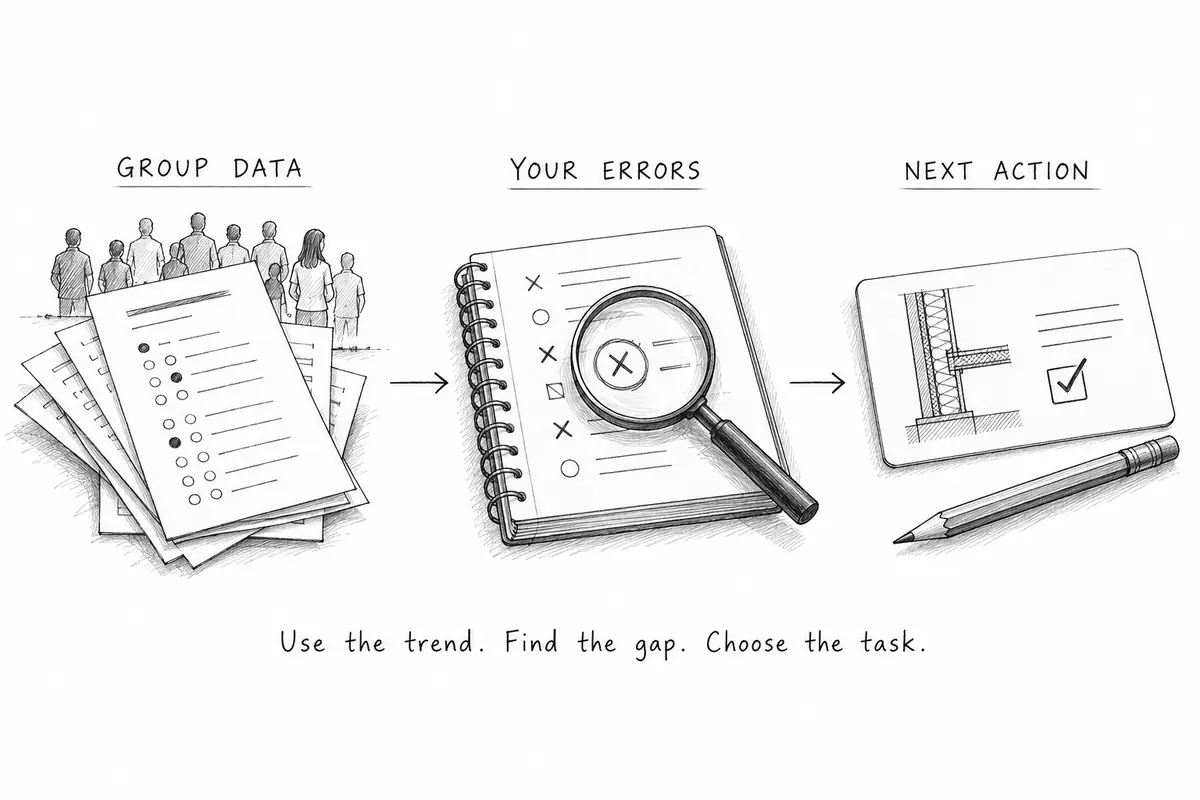
Check these tasks against the current ARE 5.0 Guidelines, effective October 1, 2026. A checklist of familiar topics is a starting point; application reveals whether you can use them.[4]
TRY TWO STUDY PROFILES
Same rates. Different prep.
Switch the experience. Watch the study task change while the national data stays the same.
2025 outcomes · first attempts + retakes · NCARB data ↗
Design experience
Materials and assemblies.
Combining systems with program constraints.
Compare two PPD design options. Explain the tradeoff.
The gap points to integration practice. A national ranking cannot reveal whether this candidate can make that decision.
Management experience
Team work plans.
Responsibility under the stated agreement.
Map a PjM scope change to the contract and communication.
The gap points to responsibility and communication. A higher national pass rate does not remove the need to practice those decisions.
Original teaching scenarios. These tasks guide review; they do not predict a result or automatically select your next exam.
An original planning example
Jordan works mainly on construction documents. They notice PjM’s higher national pass rate and assume it should be their next exam. But they have little exposure to project scheduling or contracts. Their recent PDD practice review shows a different problem: they understand many drawing relationships but struggle to coordinate specifications.
Before choosing, Jordan takes a fresh, focused look at both divisions. They record unfamiliar objectives, reasoning errors, and tasks they cannot complete independently. The comparison suggests that PDD currently has the more specific repairable gap, while PjM requires a broader foundation.
That could support taking PDD next, provided a wider review supports the decision. It could also reveal that more preparation is needed for either exam. The point is to replace "higher pass rate means easier for me" with a defensible assessment of the work ahead. This is an invented teaching scenario, not candidate research or a promised outcome.
Three mistakes to avoid
- Assigning study time in proportion to failure rates. National percentages do not tell you how many hours a particular gap needs. Estimate tasks first, then fit them into your available week.
- Treating a higher-rate division as a warm-up. Familiar job experience may leave whole objectives unpracticed. Check the scope before deciding what can be skipped.
- Repeating the same approach after a setback. Identify whether the problem was knowledge, application, reading, or time. Then change the activity that addresses that problem.
For a practical next step, use our six-division ARE 5.0 study plan. When your appointment is approaching, use the ARE exam prep readiness checklist to review evidence from your own preparation.
Frequently asked questions
What is the ARE 5.0 pass rate?
NCARB’s published overall ARE 5.0 pass rate was 55% in 2025, the same as in 2024. It counts all division attempts, including first attempts and retakes.
Which ARE 5.0 exam has the lowest pass rate?
Project Planning & Design (PPD) had the lowest 2025 pass rate at 48%. Practice Management (PcM) was next at 51%.
Which ARE 5.0 exam has the highest pass rate?
Project Management (PjM) had the highest 2025 pass rate at 63%, followed by Construction & Evaluation (CE) at 61% and Programming & Analysis (PA) at 59%.
Does the lowest pass rate mean I should take that exam last?
No. Consider current experience, overlap with recent study, and the gaps you can identify. The national ranking cannot select an exam order for an individual.
Is an ARE pass rate the score I need on a practice exam?
No. Population outcomes and individual scoring standards answer different questions. NCARB’s official practice exams have their own scoring standard; a commercial question-bank percentage is not automatically equivalent.
Where should I start if a division’s statistics make me anxious?
Choose one current objective and one unfamiliar application task. Write down the decision you missed and the evidence needed to resolve it. That gives your next study session a useful purpose.
Sources and further reading
Official sources checked October 23, 2026. Annual outcomes refer to 2025. Study prompts and the Jordan scenario are original KPath ARE teaching material.
- NCARB — ARE 5.0 Pass Rates. Annual division rates, overall results, and candidate counts.
- NCARB by the Numbers 2026 — Examination. 2025 activity, first-attempt/retake mix, and mean attempts among completers.
- NCARB — What Score Do You Need to Pass the ARE? Updated June 30, 2025. Passing standards and practice-exam scoring.
- NCARB — ARE 5.0 Guidelines. October 2026 edition, effective October 1, 2026; current division objectives and procedures.
- NCARB — Project Planning & Design. Division scope and target section weightings. Official scope pages for the other five divisions are linked in the study-prompt table.