
Studying for ARE Practice Management (PcM) or Project Management (PjM)? Utilization rate and net multiplier connect practice finances with how project teams spend their time. For PcM prep, use these ratios to interpret financial performance. For PjM prep, connect the results to staffing, fees, and scope. This lesson uses one worked example to show why more project time does not automatically produce more revenue.
Where this fits in PcM and PjM
For ARE PcM exam prep, this is primarily a practice-finance topic. NCARB’s October 2026 Guidelines place evaluating the practice’s financial well-being in PcM Objective 2.1, typically 11–15% of that division’s items. That is the entire objective’s range, not the share devoted to these two formulas.
The PjM connection is the management decision: staffing, time, fees, and scope. PjM Objective 1.2 addresses managing resources relative to project needs and fees; Objective 4.2 addresses scope changes. Use the example below as a bridge between financial interpretation and project management — not a promise about which calculation will appear on your exam.
Two formulas, two different questions
| Metric | Formula | Read the result as |
|---|---|---|
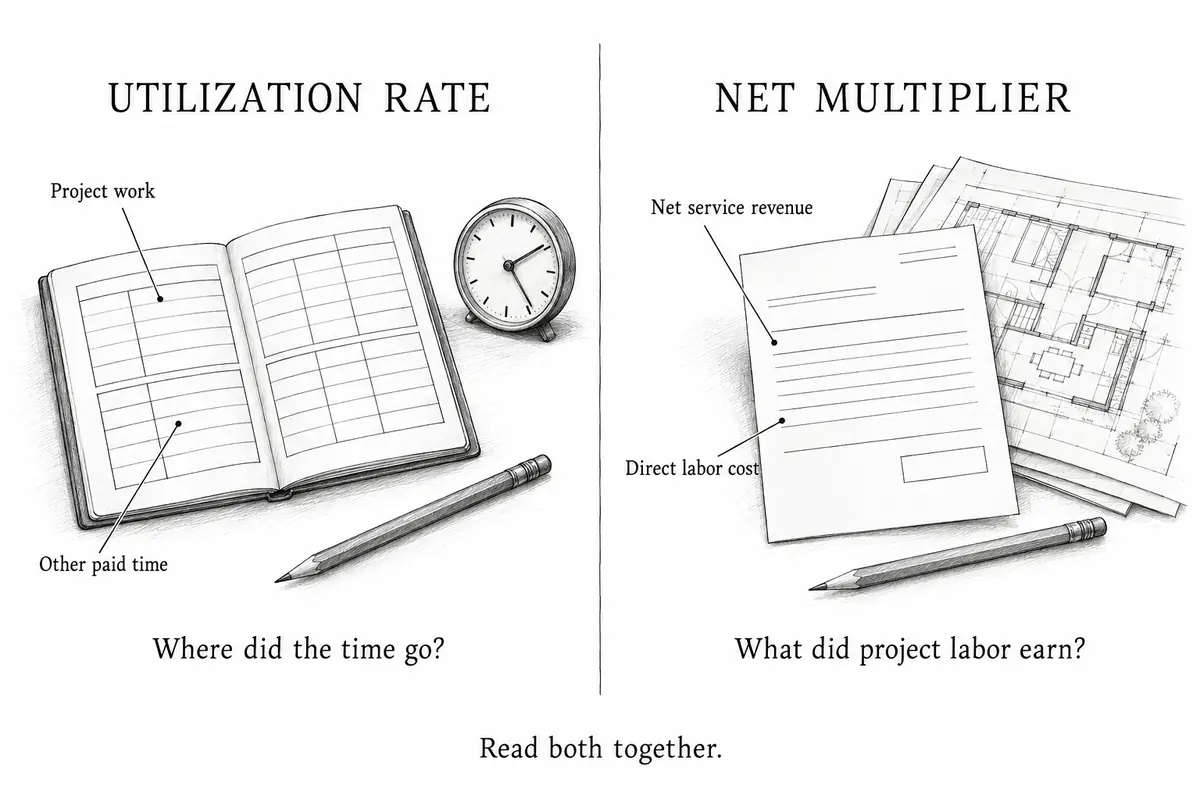
| Utilization rate | Direct labor ÷ total labor × 100% | What share of labor went to client projects? |
| Net multiplier | Net service revenue ÷ direct labor cost | How much net revenue accompanied each $1 of project labor cost? |
Direct labor cost is the firm’s wage cost for time assigned to client projects. It is not the rate charged to the client. Project time remains a cost even when the firm cannot invoice additional hours. Total labor includes direct and indirect labor. Training and business development can be necessary indirect work, rather than evidence of poor performance.
Net service revenue is revenue remaining after direct nonlabor project expenses, including consultants, are removed. It still has to support the architect’s labor and other operating costs; it is not profit. Follow the statement’s definitions rather than treating every expense as a deduction before calculating net revenue.
Hours or dollars for utilization?
AIA’s firm-finance example uses direct labor dollars ÷ total labor dollars. A time-based schedule may instead ask for direct hours ÷ total hours. Label the basis. For one person at a constant wage rate, the answers match; with different staff pay rates, a combined hours ratio can differ from the cost-weighted ratio. Never divide hours by dollars.
One original example, from timesheet to revenue
In this KPath worked example, a small studio has one employee and one fixed-fee client project during a reporting period. Assume a constant wage cost of $40/hour, no overtime premium, and matching labor and revenue periods. All figures are invented for learning, not industry benchmarks.
| Input | Amount |
|---|---|
| Total paid time | 160 hours |
| Client-project time | 112 hours |
| Indirect time | 48 hours |
| Total revenue for the period | $18,000 |
| Consultants and other direct nonlabor expenses | $4,560 |
- Calculate labor cost. Total labor = 160 × $40 = $6,400. Direct labor = 112 × $40 = $4,480.
- Calculate utilization. $4,480 ÷ $6,400 = 70%. The hours check, 112 ÷ 160, also gives 70% because the wage rate is constant.
- Find net service revenue. $18,000 − $4,560 = $13,440. Do not subtract the employee's wages at this step.
- Calculate net multiplier. $13,440 ÷ $4,480 = 3.00. Each $1 of direct labor cost is associated with $3 of net service revenue.
The $18,000 total includes money supporting outside services. Using it as the numerator would give approximately 4.02, overstating the multiplier under the stated definitions. Dividing $13,440 by total labor would give 2.10: a different metric, the payroll multiplier.
Why "busier" can produce a lower multiplier
Now compare an alternative version of that same period. Unanticipated revisions require 16 more project hours, replacing 16 hours otherwise allocated to indirect work. Total paid time stays at 160 hours. Assume revenue, consultant expenses, and wage rates stay unchanged; the fixed fee does not increase in this example.
| Measure | Original plan | More revisions |
|---|---|---|
| Project hours | 112 h | 128 h |
| Direct labor cost | $4,480 | $5,120 |
| Total labor cost | $6,400 | $6,400 |
| Utilization | 70% | 80% |
| Net service revenue | $13,440 | $13,440 |
| Net multiplier | 3.00 | 2.625 → 2.63 |
Utilization rises 10 percentage points, while the multiplier falls. The project consumes more labor for the same net revenue. However, total payroll and net revenue remain unchanged here, so this comparison alone does not demonstrate a reduction in whole-firm operating profit. It reveals greater project labor consumption and less time for other work.
The useful PjM response is to investigate the cause: changed owner requirements, coordination problems, underestimated effort, or another documented issue. Then review the work plan and agreement, communicate the effect, and address any fee or scope adjustment through the applicable process. Do not assume every revision automatically earns additional compensation — or move project time into an indirect category to improve a ratio.
As a cross-check, both outcomes have a payroll multiplier of 2.10: 0.70 × 3.00 = 0.80 × 2.625. That identity works when utilization uses labor dollars and all figures cover the same reporting scope. AIA explains the relationship between these metrics; the numbers here are our own illustration.
Four mistakes to catch in ARE exam prep
- Using the billing rate as labor cost. In our example, the denominator uses $40/hour wages, not a client charge-out rate.
- Calling 3.00 a 300% profit margin. It is a revenue-to-direct-labor multiple; other costs remain.
- Treating 100% utilization as everyone’s goal. Ask who needs to do supervision, training, proposals, and firm management.
- Reading one number as a verdict. A strong multiplier does not prove adequate workload, cash collection, or overall profitability.
ARE PcM & PjM practice: choose, then check
Three original practice questions. Choose an answer for immediate feedback, then compare the reasoning. These are not actual NCARB exam questions.
Three questions · Check your reasoning below
Quick questions
Is a 3.00 net multiplier always good?
No. Compare it with the firm’s cost structure, budget, and project conditions. The example’s 3.00 is a teaching result, not a universal target or a passing threshold.
Does higher utilization mean staff worked faster?
No. It measures labor allocation, not completed work per hour. Rework can increase project time without increasing useful output.
What should I remember first?
Use the KPath two-question check: "Where did labor go?" Then, "What net revenue did that project labor support?" Name the quantities before choosing a formula.
Course lessons and sources
Continue in the KPath course
Continue with the related KPath lessons.
Utilization ratePCM-D10-UTIL-001 Net multiplierPCM-D11-MULT-002 Resource allocationPJM-D31-RES-001Lessons open in your KPath account — sign in or create a free account to continue.
Checked October 24, 2026. These are accounting concepts, not building-code requirements. NCARB references use the October 2026 Guidelines, effective October 1, 2026. AIA references explain the financial definitions; worked scenarios and practice questions are original teaching examples.
- AIA Best Practices: Budgeting key performance indicators: definitions of labor, utilization, and net multiplier, pp. 2–3. General benchmark discussions are not treated here as current survey data.
- NCARB ARE 5.0 Guidelines: PcM Objective 2.1, p. 74; PjM Objective 1.2, p. 79; Objective 4.2, p. 82. Objective weight ranges refer to typical exam forms, which may vary.
- AIA Best Practices: Accounting basics — the income statement and KPIs: net revenue and direct nonlabor project expenses, p. 2.
- AIA: Accounting basics — The income statement & KPIs: net and payroll multipliers and the relationship with utilization. Published December 1, 2023; used for definitions, not a 2026 benchmark.