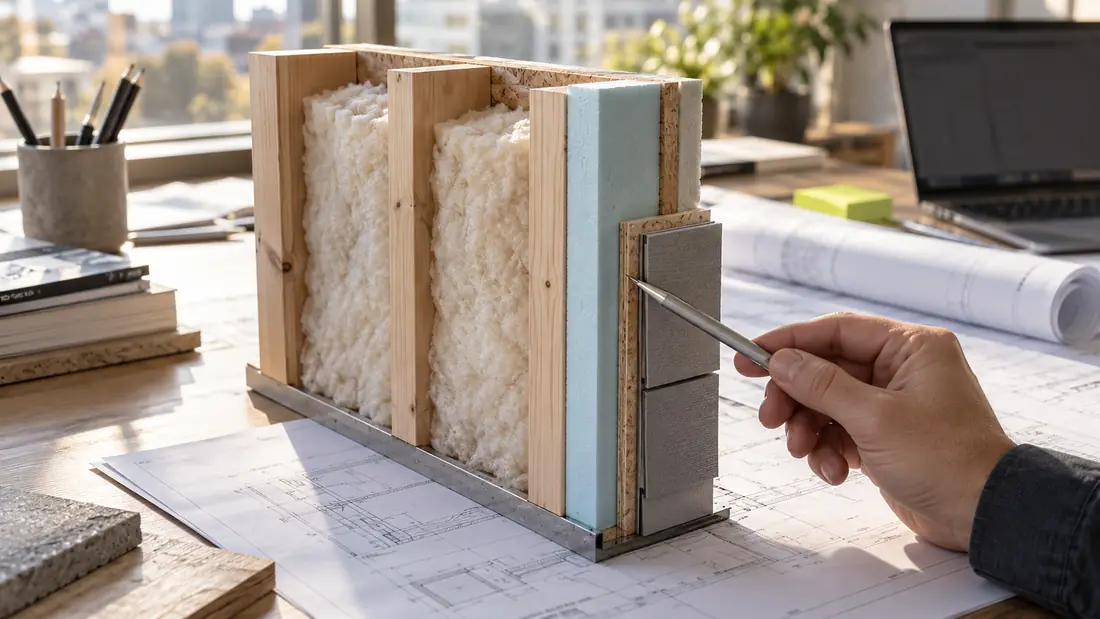
Thermal bridging happens when heat passes more easily through part of a building enclosure — a stud, a slab edge, a metal connection — than through the insulation around it. Insulation between studs helps the bays, but the studs still provide a conductive path. Continuous insulation reduces the problem by extending across the framing.
For ARE Project Planning & Design (PPD) and Project Development & Documentation (PDD), focus on three decisions: find the bridge, identify what the insulation covers, and choose a response that addresses that bridge. This KPath study guide practices those decisions with a wall comparison, an interactive model and three original practice questions.
1. Understand the wall, not just the batt
Picture a wall with insulation fitted neatly between wood studs. The insulated bays resist heat flow, but the wood interrupts that insulation, so heat can still travel through the studs. Steel framing is an even more conductive path, so filling the bays alone does not resolve the bridge.
The important distinction is simple: the insulation’s labeled R-value does not describe the performance of the entire wall. Other layers, the framing and the connections also matter. Exterior insulation improves performance by covering the framing as well as the bays.
Keep the basic vocabulary straight: higher R-value means greater thermal resistance; lower U-factor means less heat transmission, when comparing equivalent conditions. You do not need a detailed wall calculation to explain why a continuous layer helps at the framing.
2. Cavity insulation vs. continuous insulation
| Strategy | What it does | What to notice |
|---|---|---|
| Cavity insulation | Fits between the studs. | The framing still interrupts the insulation. |
| Continuous insulation (ci) | Extends across the framing and the bays. | It reduces bridging through the elements it covers. |
Adding better insulation within a bay can improve the wall. But if the stated problem is heat transfer through the studs, a continuous layer addresses that problem more directly.
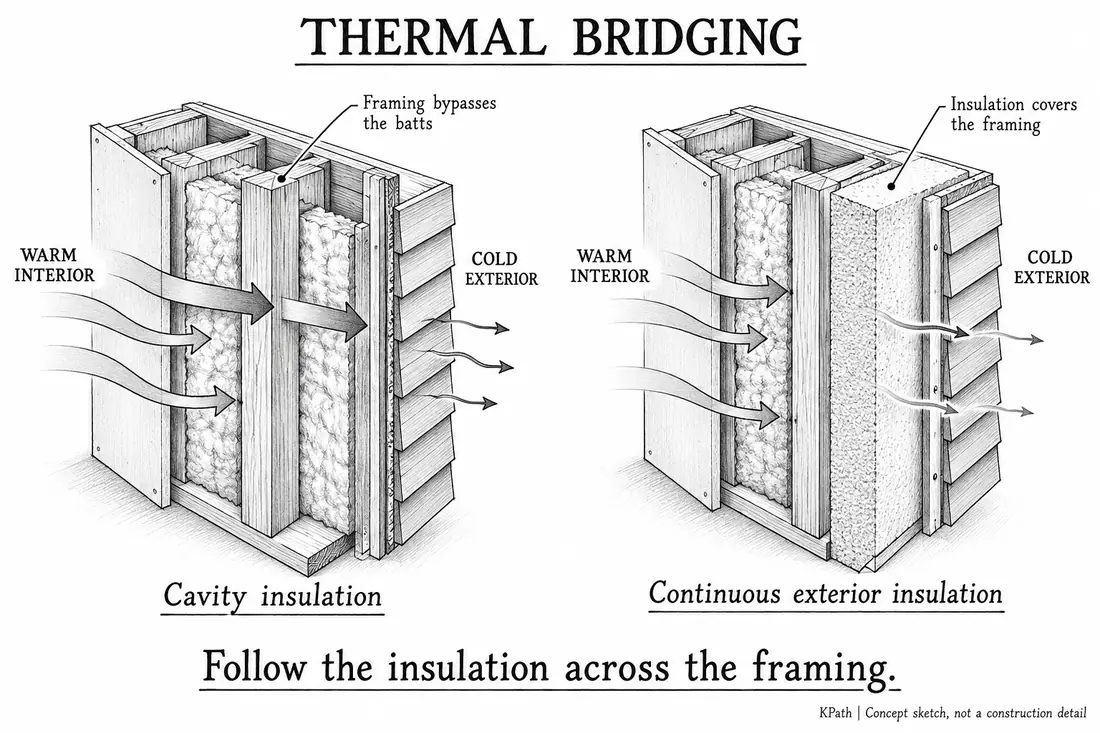
When reviewing a detail, follow the insulation at windows, roof edges and floor edges. A continuous layer in the middle of a wall does not prove continuity at every junction — attachments and penetrations can still create bridges.
Put the insulation across the framing.
Drag the green panel into the dashed slot on the exterior side.
Concept section · arrows show paths, not measured heat flow.
Cavity insulation alone leaves the framing routes untreated.
3. Apply it to a design question
An architect is reviewing an exterior steel-stud wall. The bays are insulated, but the design team is concerned about thermal bridging through the studs. Which change most directly addresses the concern?
- Increase insulation within the same stud bays.
- Add continuous insulation across the exterior face of the framing.
The second option directly addresses the stud path. The first improves resistance in the bays, while the steel remains a conductive connection. The continuous layer adds resistance across both the framing and the bays.
Now change the problem: the concern is air leaking at a window perimeter. More exterior insulation alone is not a complete answer — you would investigate the continuity and sealing of the air-control layer. Match the response to the failure described.
How this shows up by division:
- PPD — selecting an enclosure strategy early: cavity-only versus continuous insulation, and the climate and energy goals behind the choice.
- PDD — tracing that strategy through the details: slab edges, window perimeters, parapets, shelf angles and other places where the thermal layer can break.
4. Avoid three common mix-ups
"A higher insulation R-value always means the better wall."
Check what the rating describes. A higher batt rating is useful, but it does not tell you how the framing and the junctions affect the complete assembly.
"An air barrier stops thermal bridging."
Air barriers control air movement; insulation resists heat transfer. Sealing around a metal connection does not remove the conductive path through the metal. One product may serve several functions, but those functions still need to be distinguished.
"Continuous insulation solves every connection."
Look at the actual detail. A projecting slab, balcony or metal support may cross the thermal layer. The next question is how that connection is treated — not whether insulation appears somewhere on the wall.
5. Check your understanding
These three original practice questions train you to identify the problem and choose a targeted response.
Want more? KPath’s PPD + PDD course covers envelope control layers lesson by lesson, with practice questions that link back to the exact knowledge point.
Frequently asked questions
What is thermal bridging in a building?
Thermal bridging is heat flowing through a part of the building envelope that conducts heat more easily than the insulation around it — for example a wood or steel stud, a concrete slab edge, a balcony or a metal connection that crosses the insulation layer.
What is the simplest way to recognize a thermal bridge?
Look for a relatively conductive material that crosses or interrupts the insulation, such as a stud, slab edge or connection. Then ask whether the proposed insulation actually covers that path.
Is cavity insulation ineffective?
No. It improves the insulated bays. The distinction is that it does not provide a continuous insulating layer across the framing, so the studs remain a heat path.
How does continuous insulation reduce thermal bridging?
Continuous insulation is installed across the face of the framing, usually on the exterior, so heat that would travel through the studs must also pass through insulation. It reduces the bridge but does not make the framing nonconductive, and penetrations through it still need their own treatment.
What should I remember about R-value and U-factor for the ARE?
For equivalent conditions, a higher R-value means more thermal resistance, and a lower U-factor means less heat transmission. Always check whether the number describes a single product or the whole assembly.
Which ARE 5.0 divisions test thermal bridging?
Thermal bridging and continuous insulation appear in Project Planning & Design (PPD), when you choose an enclosure strategy, and in Project Development & Documentation (PDD), when you check that the thermal and air layers stay continuous through the details.
Course lessons and sources
Continue in the KPath course
Review the connected knowledge points.
Common thermal bridges in envelope detailsSHR.D5.HEAT.004 Why continuous exterior insulation mattersSHR.D7.INSU.002 Tracing the air barrier in sectionSHR.D5.AIR.006Lessons open in your KPath account — sign in or create a free account to continue.
Sources checked October 21, 2026. Examples, questions and the study sequence are original KPath teaching material.
- AIA — Definitions for building performance: thermal bridges and control-layer vocabulary.
- U.S. Department of Energy — Continuous rigid insulation on exterior walls: framing and the role of exterior insulation.
- NCARB — Project Planning & Design (PPD): official division scope.
- NCARB — Project Development & Documentation (PDD): official division scope.