
Preparing for ARE PPD or PDD? An air barrier and a vapor retarder can occupy the same layer, but they answer different questions. Before choosing a membrane or correcting a detail, identify how moisture is moving. A product that slows vapor diffusion does not automatically solve a leak around a window.
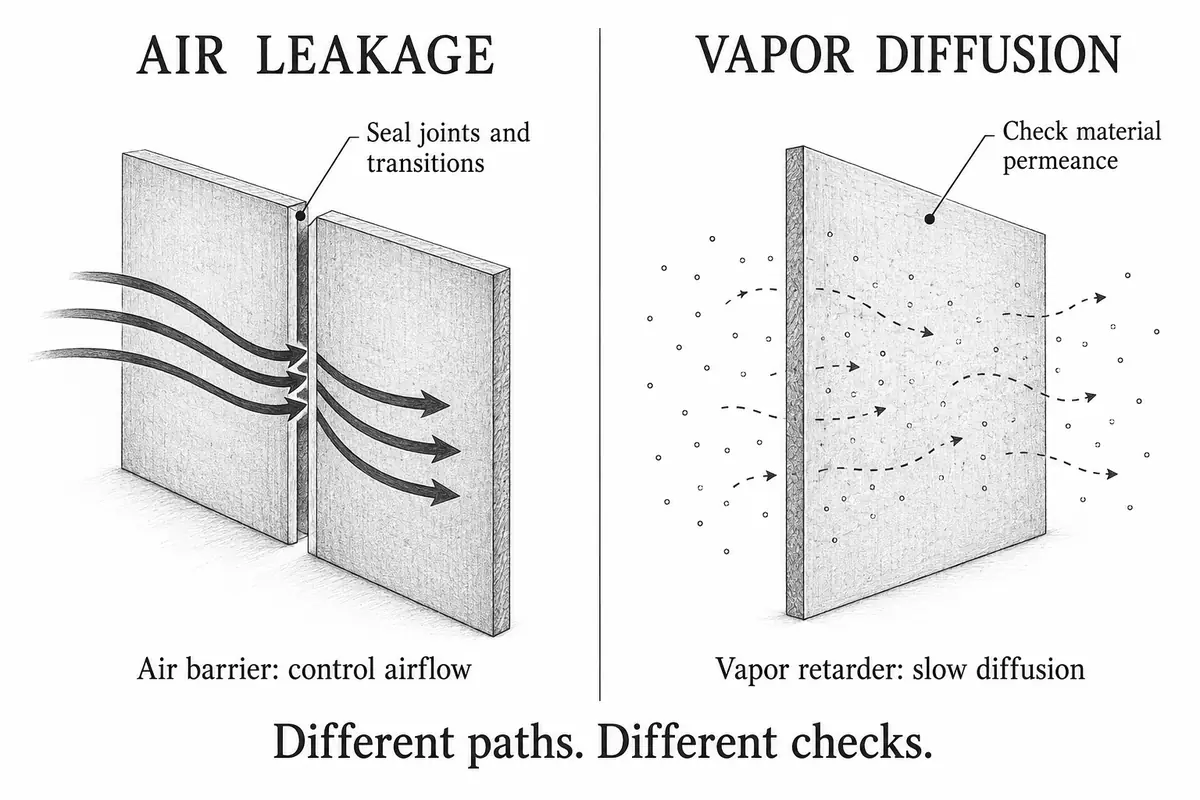
Air movement and vapor diffusion are different paths
Air leakage is air moving through openings or connected leakage paths. Wind, stack effect, or mechanical systems can create the pressure difference that drives it. Seams, penetrations, and connections between enclosure components therefore matter — not just the material across the middle of a wall.
Vapor diffusion is water vapor moving through materials. It can occur through an intact layer without a visible hole. Vapor permeance describes how readily a material layer transmits vapor: lower permeance means greater resistance to that transport. Calling a layer "airtight" does not, by itself, tell you its vapor permeance.
| Question | Air barrier | Vapor retarder |
|---|---|---|
| Primary job | Control airflow through the enclosure. | Slow vapor diffusion through materials. |
| First check | Is the system continuous at joints and transitions? | Does the vapor resistance suit this assembly and exposure? |
| What a label cannot prove | Air control alone does not establish vapor resistance. | Vapor resistance alone does not establish an airtight installed system. |
The comparison separates functions, not necessarily products. A suitable membrane may provide air, water, and vapor control. Another air-control layer may permit more vapor transmission. Read the specified performance rather than assuming that every "barrier" does the same thing. ASHRAE explicitly recognizes that a single layer can serve air and vapor control.
The PPD decision and the PDD detail
NCARB’s October 2026 Guidelines connect PPD with selecting materials and assemblies and integrating building systems. PDD addresses detailing that integration and coordinating construction documents and specifications. The teaching distinction below applies that scope to this topic; it does not predict a particular exam question.
For PPD prep: explain why the proposed enclosure strategy fits the project’s conditions. What movement needs controlling? What indoor conditions are expected? How can the assembly dry? A familiar material name is not enough to make the choice.
For PDD prep: follow the selected strategy through the detail. Where does the wall air-control layer connect to the window, roof, or foundation? Do the drawings and specifications describe compatible transitions? Naming the right membrane in a schedule does not complete those connections.
One original scenario: a draft at a window
In this KPath PPD/PDD example, a small library has a specified wall membrane and insulated cavities. During a pressure test, smoke tracing identifies air movement at the junction between the rough opening and the window frame. The membrane is intact across the adjacent wall face. Assume the observed airflow path, rather than a rain leak or a calculation of diffusion, is the problem being investigated.
A proposed response is to replace the membrane with a product having lower vapor permeance. That changes a material property. It does not, by itself, close the identified connection.
- Name the mechanism: the evidence identifies airflow through a junction.
- Follow the intended air-control path: locate the connection from the wall layer to the window assembly.
- Find what is missing: determine whether the transition is absent, discontinuous, poorly bonded, or otherwise unable to maintain the intended seal.
- Choose the targeted response: provide a compatible, durable transition and verify the result. Review drainage and other required functions alongside that connection.
The best response addresses the observed path. It is not a universal instruction to tape every exterior joint closed: window assemblies may include designed drainage openings, and transition details must respect those functions. Nor does a successful air seal prove that the wall’s vapor-control strategy is suitable.
PNNL’s Building America guidance recommends identifying the air barrier on plans and maintaining continuity across enclosure components, including seams and penetrations. Its examples are residential; the lesson here is the continuity principle, not an imported set of residential installation requirements for every building.
KPATH TWO-PATH CHECK · PPD / PDD
Two paths. Two separate checks.
Each model has its own responses and feedback. Try the air-leakage check first, then compare it with diffusion.
01 · Air leakage
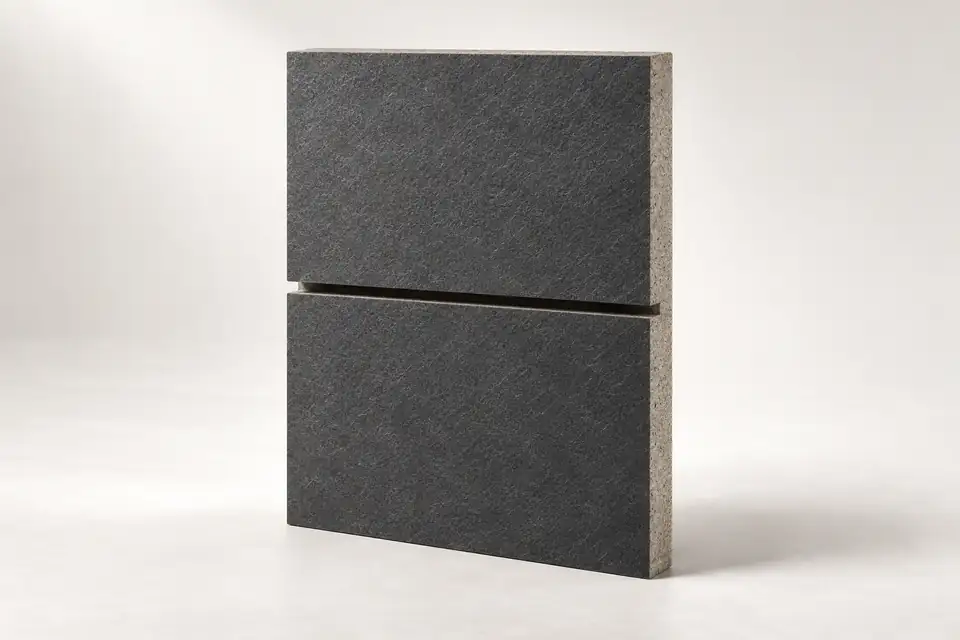
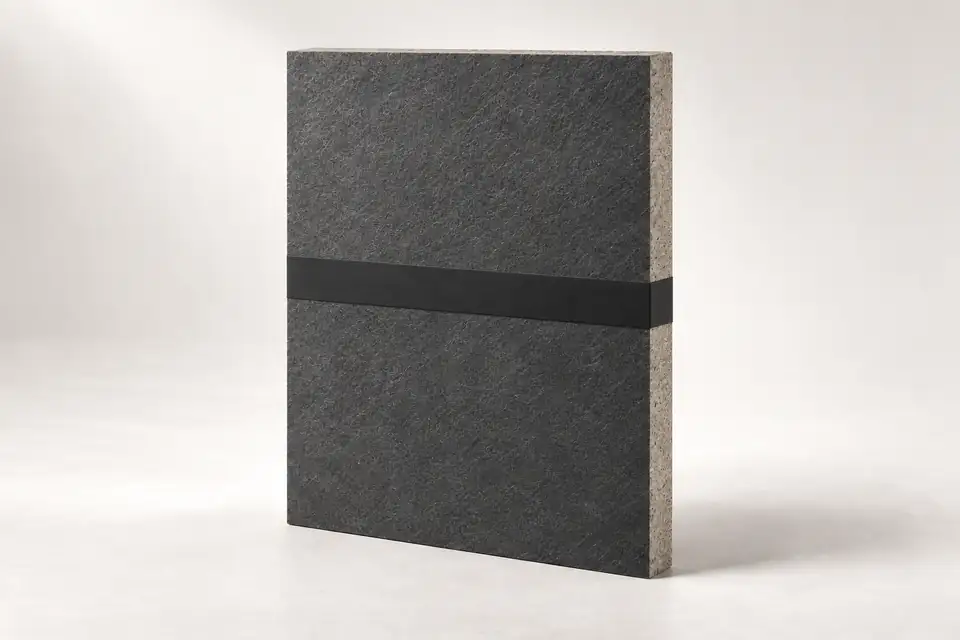
A pressure test identifies airflow at an open junction. The adjacent material is intact.
TRY A RESPONSE · AIR LEAKAGE
The observed path passes through the junction. Repair that connection rather than assuming a material-property change closes it.
02 · Vapor diffusion
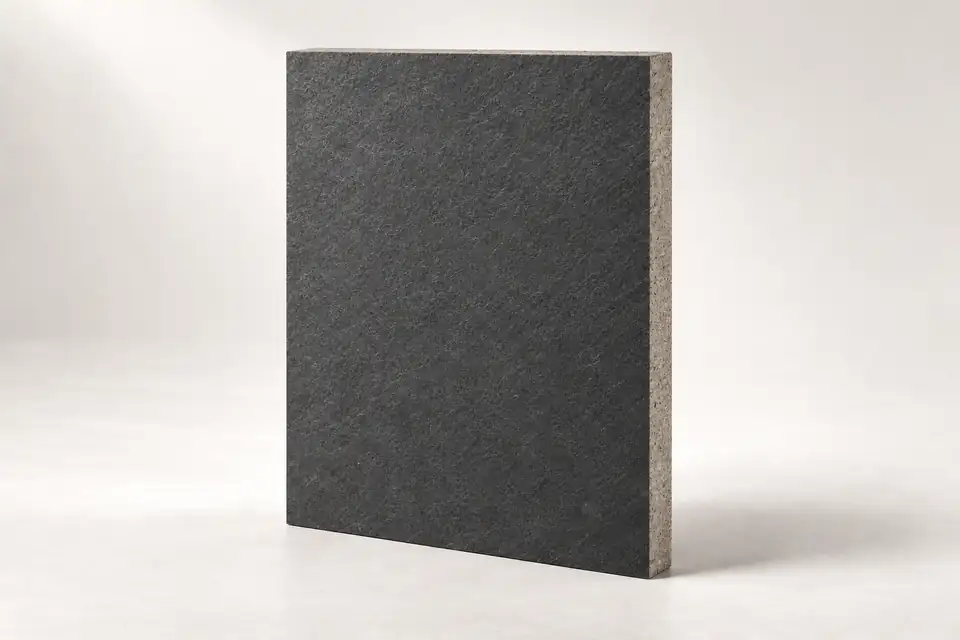
An intact layer transmits water vapor under a vapor-pressure difference. No air leak has been identified in this scenario.
TRY A RESPONSE · VAPOR DIFFUSION
Evaluate the intact material's vapor permeance with climate, indoor conditions, and the assembly's drying strategy.
Concept models only: an identified air-leakage path, or diffusion through intact material under a vapor-pressure difference. No measured flow, climate-specific placement, or complete wall assembly is modeled. The specimens are abstract material coupons, not construction details. Visible trails, paths, timing, and direction are illustrative.
The principle behind both models
For an identified air leak, repair the air-control connection. Lower vapor permeance alone leaves an open junction unresolved. For diffusion through intact material, evaluate vapor resistance with climate, indoor conditions, and drying potential. Sealing a junction alone does not change the adjacent material's vapor permeance. A suitable layer may serve both functions.
Why vapor control needs a drying strategy
A more vapor-resistant layer can also limit drying through that layer. Climate, indoor conditions, and the rest of the assembly affect where vapor control belongs and how restrictive it should be. Low-permeance layers on both sides deserve scrutiny because they can leave little drying potential if moisture enters. This is a risk to evaluate, not proof that every such assembly fails.
For an original concept exercise, compare a heating-dominated project with an air-conditioned building in a warm-humid location. Copying an interior vapor-control strategy from one to the other without reviewing the new conditions misses the design question. Start with expected wetting and drying, then assess the whole assembly.
Avoid the shortcut "vapor barriers always go inside." Also avoid replacing it with "always outside in hot climates." Neither sentence provides the full conditions needed for an assembly choice. The relevant code edition, jurisdiction, materials, and project requirements must support a real specification. This article teaches the distinction without prescribing a universal wall stack.
Three traps in ARE PPD/PDD prep
- Equating insulation with air sealing. Insulation may have other functions, but an R-value alone does not establish an airtight enclosure.
- Using "moisture barrier" without naming the mechanism. Bulk rain, air-carried moisture, and diffusion raise different questions. A drawing note should identify the intended function.
- Assuming vapor control means a separate plastic sheet. The needed resistance may be provided by an assembly component or coating. Verify the actual properties and conditions.
ARE PPD & PDD: three original checks
Original learning questions, not actual NCARB exam items. Choose an answer for feedback and a full explanation. This short exercise does not predict exam readiness.
1. Which correction targets the observed defect?
Air moves through an unsealed wall-to-window connection. Which action most directly addresses it?
- Add cavity insulation.
- Repair the air-control transition.
- Specify lower vapor permeance without changing the connection.
- Increase the wall's interior paint thickness without reviewing the junction.
Answer & explanation
B. It addresses the airflow path. A targets thermal resistance; C changes diffusion resistance while leaving the gap; D does not demonstrate a repaired junction. Other enclosure checks still matter.
2. Can an air barrier be relatively vapor-permeable?
Choose the statement that distinguishes airflow from vapor diffusion.
- Yes; airflow and vapor diffusion are different properties.
- No; airtight always means vapor-impermeable.
- Only if it has open seams.
- Only if it also replaces insulation.
Answer & explanation
A. The properties must be assessed separately. B conflates them. C describes an air-control defect, not a requirement for diffusion. D adds an unrelated thermal function.
3. Which information supports a vapor-control choice?
Which information is most useful when evaluating a vapor-control strategy?
- The membrane's color.
- The claim that the wall is airtight.
- Climate, indoor conditions, and the assembly's wetting and drying behavior.
- The rule that more vapor resistance is always better.
Answer & explanation
C. It considers the conditions that determine the strategy. A is not performance evidence; B leaves vapor behavior unresolved; D ignores drying potential.
Quick questions
Are vapor barrier and vapor retarder interchangeable?
Terminology varies. "Vapor barrier" commonly describes a very vapor-resistant retarder. Check the specified classification and tested properties rather than treating the word alone as a performance specification.
Does an air barrier stop rain?
Air control does not automatically establish rain control. A product may perform both functions, but the water-control layer also needs appropriate flashing and drainage connections.
What should I remember for PPD and PDD?
Use the KPath two-path check: air through openings — follow continuity; vapor through materials — check resistance and drying. Then connect the chosen material to the surrounding assembly.
Course lessons and sources
Continue in the KPath course
Continue with the related KPath lessons.
Air leakage and vapor diffusion are different mechanismsSHR.D5.AIR.003 Vapor permeance, retarder classes, and condensationSHR.D5.VAP.001 Tracing the air barrier in sectionSHR.D5.AIR.006Lessons open in your KPath account — sign in or create a free account to continue.
Checked October 25, 2026. No code-class thresholds, prescribed wall placement, or numerical leakage criteria are asserted. Older technical references support principles, not a claim about the currently adopted code in every jurisdiction.
- DOE Building Science Education: Air Barriers vs. Vapor Barriers: different moisture-transport functions and dependence on climate and construction.
- ASHRAE Handbook — Fundamentals (2021), Chapter 26: Sections 2–3 address air barriers, vapor retarders, material properties, and drying. Used as technical background, not a current code mandate.
- NCARB ARE 5.0 Guidelines, October 2026: effective October 1, 2026; PPD materials/assemblies and integration objectives; PDD detailing and documentation objectives.
- PNNL Building America Solution Center: Continuous Air Barrier in Exterior Walls: continuity, seams, and transitions. Residential/program-specific provisions are not presented here as universal requirements.
- Joseph Lstiburek: BSD-106, Understanding Vapor Barriers: April 15, 2011; original discussion of climate, vapor resistance, and drying. Historical code statements in this paper are not adopted as present-day code guidance.