PPD + PDD · DAY 03EN / 中文 / ES
← Back to roadmap
SITE, ENVIRONMENT, CLIMATE & ZONING
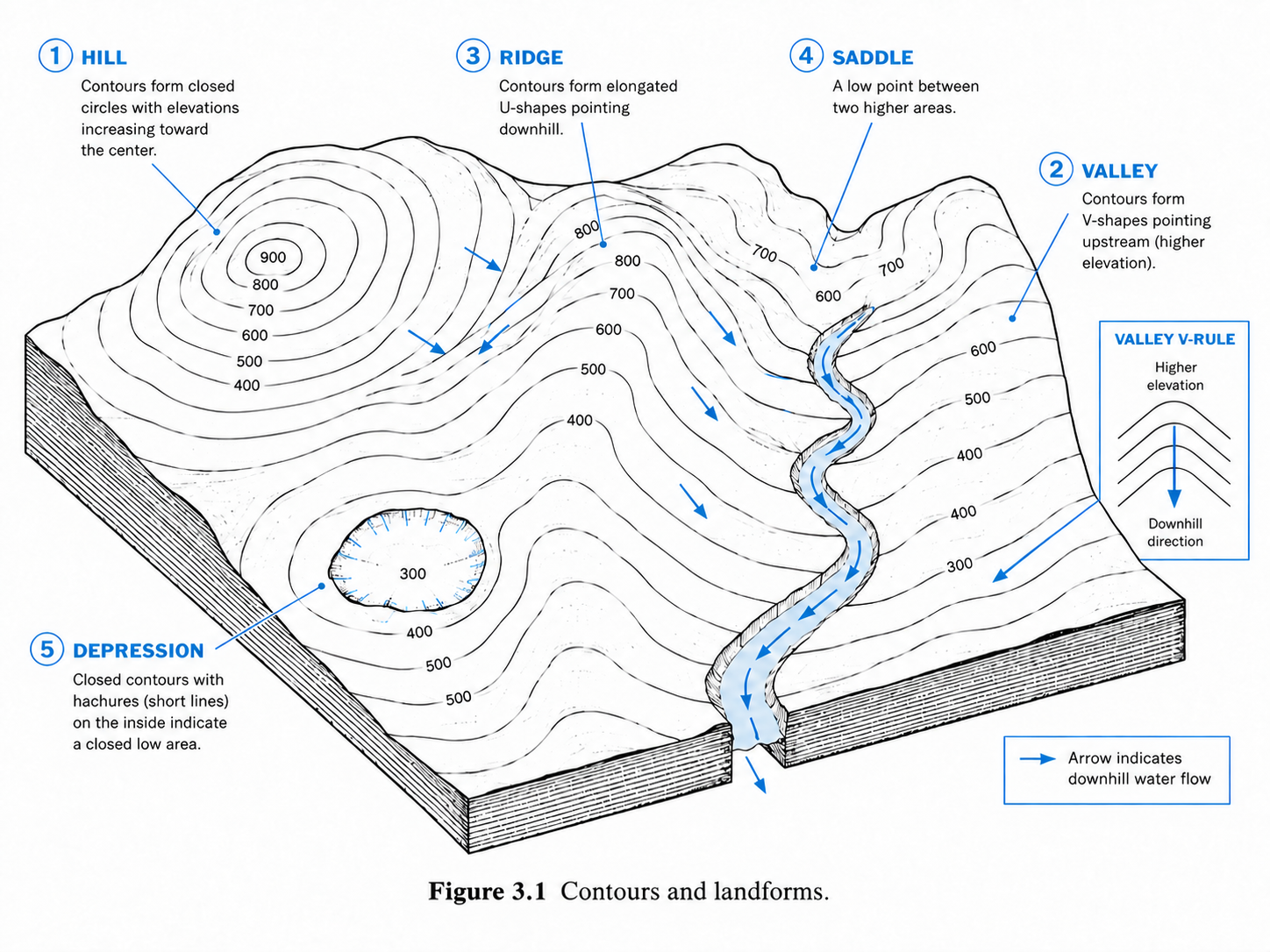
Contour density &
landform recognition
SHR.D1.TOPO.001 R2
Key takeaway
Read spacing first, then elevations, then water flow.
A CLEARER PATH TO YOUR ARCHITECTURE LICENSE
Day-by-day courses. Illustrated knowledge points. Practice connected by KP Code. One place to learn, ask, and keep moving forward.
← Back to roadmap
SITE, ENVIRONMENT, CLIMATE & ZONING
Read spacing first, then elevations, then water flow.
 Course AI assistantFind a topic. Go a little deeper.
SIX DIVISIONS. ONE CONNECTED STUDY PATH.
THE PLATFORM, CONNECTED
Build understanding before you test it. KPath brings your courses, questions, explanations and review into a study path you can follow.
01 / A CLEAR NEXT STEP
Follow organized modules and daily lessons, with knowledge-point ratings that help you see what deserves attention. Your roadmap keeps the next lesson in reach.
A structured path through Project Planning & Design and Project Development & Documentation.
D3–D9 · PPD focus
When a contour crosses a valley or stream channel, the V points upstream toward higher elevation. Water flows in the opposite direction.
The contour V points upstream; water flows downhill.
Check the elevation labels before choosing the flow direction.
02 / SEE THE PRINCIPLE AT WORK
Read the diagram alongside the explanation. Course lessons bring together labeled illustrations, the key takeaway and the exam trap, so a technical idea becomes easier to recognize.
See the parts, relationships and flows.
Keep the central idea close as you read.
Understand the distinction that changes an answer.
03 / LEARN IT. APPLY IT. CONNECT IT.
A KP Code identifies a knowledge point in the course. Course-grounded practice uses that reference to connect the question and its explanation back to the concept.
← Back to roadmap
The V in a contour points upstream toward higher elevation. Water flows toward the lower elevation.
Recognize the shape. Check the labels. Follow the flow.
A contour line crosses a stream and forms a V. The V points northeast toward elevation 220 ft; elevations decrease southwest. Which direction does water flow?
A valley V points upstream toward higher elevation, so water flows southwest toward lower elevation.
Course content and lesson practice shown in the current product layout.
04 / ASK AS YOU LEARN
The course AI assistant helps you find where a topic lives, or go deeper on a knowledge point. Ask while the concept is still in front of you.
Locate the relevant lesson in your course.
Ask for an explanation of the concept you are studying.
Assistant questions use your plan’s credits.
PPD + PDD · DAY 03
Understand how contours, elevations and drainage work together.
Find a topic, or go deeper on any knowledge point.
Ask about a topic or knowledge point in this course.
Each question costs 1 credit
A HOME FOR YOUR STUDY ROUTINE
Keep your credits, practice accuracy and exam timeline in view. Pick up a course, start a session, or return to what needs another look.
KPath AREEN / 中文 / ESHere's your study snapshot.
See what's shipping and what's planned, and tell us what to fix or build next.
Beta feature — available to test users only, for now.Choose a division and start a focused practice session.
Follow a guided, day-by-day path through each exam's content.
Example dashboard · illustrative study data
Open the dashboard ↗Coverage
Every ARE 5.0 division now has a complete structured course and practice questions — course-grounded AI practice, plus a 200-question fixed set for every division — 1,200 questions in all. The California Supplemental Exam (CSE) has practice questions live, and its course is on the way.
Business operations, firm and project finance, and practice-wide risk management.
Project budgets, schedules, contracts, and construction phase management.
Bidding, contract administration, construction observation, and project closeout.
Environmental analysis, programming, and codes applicable to project scope.
Environmental conditions, codes, building systems, project integration, and cost.
Material systems, construction documentation, specifications, codes, and cost estimates.
California-specific practice: contracts and the Practice Act, discretionary approvals and CEQA, state codes and agencies, bidding and construction.
By the numbers
A snapshot of what's actually inside KPath today — pulled straight from the course content and our beta program, not marketing copy.
ARE 5.0 divisions covered, plus the California Supplemental Exam (CSE)
Beta testers practicing with KPath since our 2026 launch
PPD and PDD, and PcM and PjM, each share a large pool of knowledge points between their paired courses — shared points are counted once for each division they apply to.
Early feedback
Real notes from architects using KPath while they study for the ARE — shared with permission.
“I started using KPath toward the end of my ARE journey, mainly for PPD and PDD. What I found really helpful was being able to jump straight back to the relevant lesson whenever I missed a question. It saved me from digging through tons of material just to review one concept. I’ve since passed PPD, PDD, and the CSE, and I’m finally getting close to becoming a licensed architect!”
“The AI assistant is probably my favorite part. Sometimes I need more than just an explanation of why B is correct. I can keep asking follow-up questions, and it actually walks me through the reasoning, almost like having a tutor there with me. Really helpful when I’m studying on my own.”
“I really appreciate how visual the lessons are. The diagrams make complicated concepts much easier to understand, especially the technical stuff that’s hard to picture from text alone. Everything is clearly organized, and I find myself going back to the illustrations when reviewing.”
“I’m definitely one of those people who learns by doing a ridiculous number of practice questions. Being able to keep generating new ones is a huge plus for me. I can just keep practicing instead of going through the same set over and over. It’s honestly made studying a lot more enjoyable.”
FAQ